

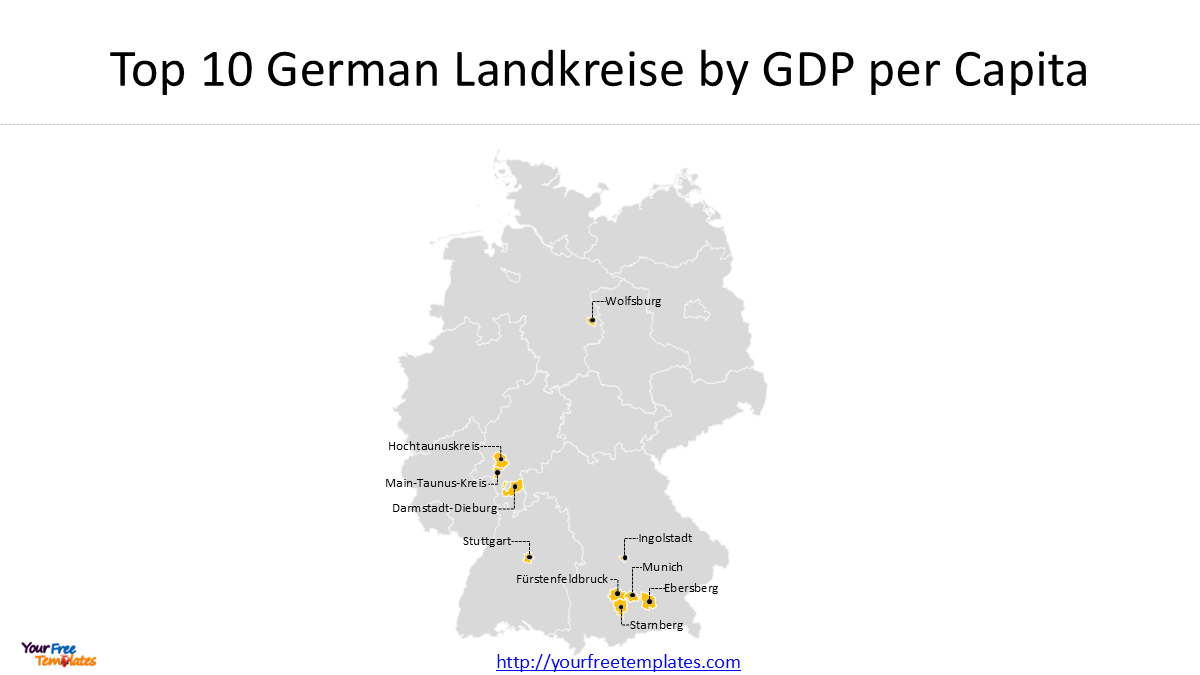
When analyzing the Highest GDP per Capita German Districts, it becomes evident that Germany’s economic powerhouse is not defined by its largest cities alone, but by a network of industrial districts where global corporations anchor hyper-productive local economies. Wolfsburg, home to Volkswagen, leads this ranking with a staggering GDP per capita of approximately €182,000—more than three times the national average. This German Landkreise GDP ranking reveals that the wealthiest districts in Germany are concentrated in the south (Bavaria and Baden-Württemberg) and in a few industrial enclaves such as Wolfsburg and Ingolstadt, where automotive manufacturing dominates.
Below, we rank Germany’s ten most economically productive Landkreise (districts) and kreisfreie Städte (urban districts) by GDP per capita, exploring the drivers behind their extraordinary wealth. To help you visualize this data, we have created an 11-slide PowerPoint deck featuring the national map of Germany with all ten district boundaries (Landkreis level) on slide 1, followed by individual enlarged district-level maps for each district on slides 2 through 11.
You can check our largest cities series as below.
- Top 10 Largest Cities in France
- Top 10 Largest Cities in Netherlands
- Top largest cities in UK
- Top largest cities in Germany
- Top largest cities in US
- Top largest cities in Canada
- Top largest cities in Australia
- Top largest cities in Austria
- Top largest cities in Switzerland
- Top largest cities in Spain
- Top largest cities in Belgium
- Top largest cities in Sweden
Understanding Germany’s Landkreis Boundaries
The Landkreis (district) is an administrative level above municipalities but below federal states (Bundesländer). As of 2026, Germany has approximately 294 Landkreise (rural districts) and 106 kreisfreie Städte (urban districts that are not part of a rural district). When we refer to GDP per capita, we are measuring the gross domestic product generated within each district divided by its population. This metric reflects economic productivity, industrial concentration, and wealth. Our accompanying PowerPoint slides use precise shapefile data to outline each district at the Landkreis level.
Germany’s national GDP per capita is approximately €48,000 (2026 estimate). The districts in this ranking all exceed €80,000, with the top district surpassing €180,000—demonstrating extreme economic concentration in specific industrial clusters. The data is based on 2025-2026 estimates from the Federal Statistical Office (Destatis) and the German Economic Institute (IW Köln).
The Ranking: Top 10 German Landkreise by GDP per Capita
All figures are 2025-2026 estimates.
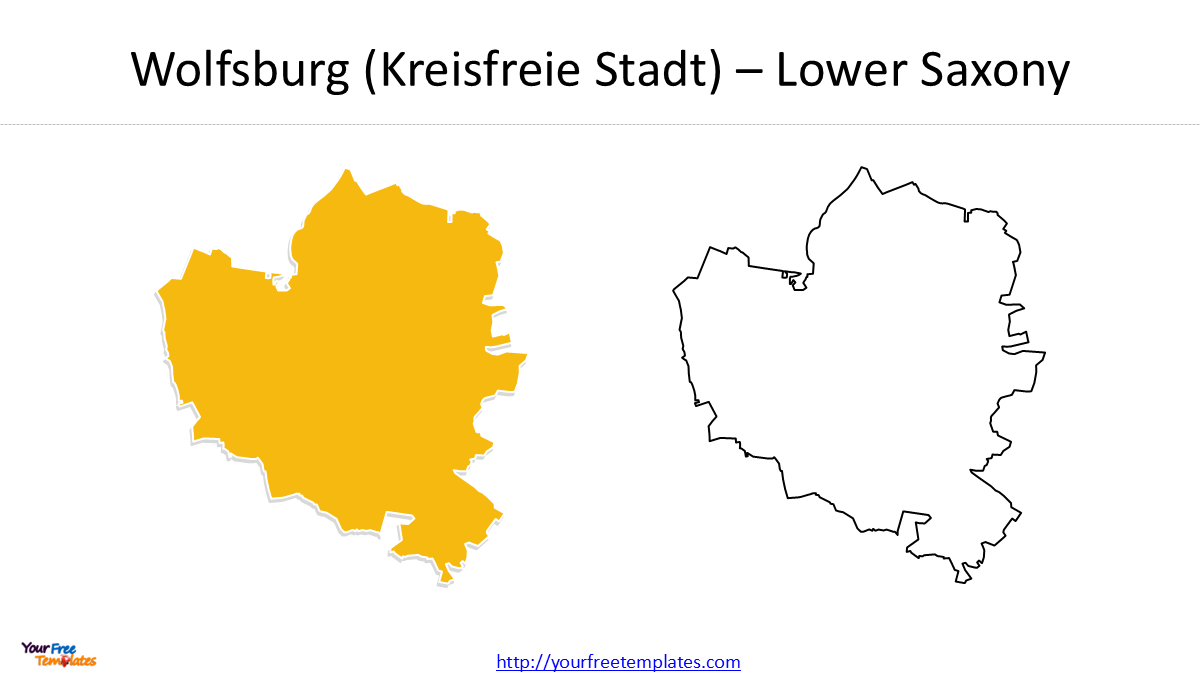
1. Wolfsburg (Kreisfreie Stadt) – Lower Saxony
GDP per Capita: Approximately €182,000
Federal State: Lower Saxony (Niedersachsen)
Population: Approximately 125,000
Wolfsburg is Germany’s richest district by GDP per capita—and by a substantial margin. The city was founded in 1938 as a planned settlement for the Volkswagen factory, and the company’s headquarters and main production plant remain the dominant economic force.
Why Highest GDP per Capita:
-
Volkswagen (VW) Headquarters: The Volkswagen Group, one of the world’s largest automakers, is headquartered in Wolfsburg. The VW Wolfsburg plant is the largest automobile factory in the world by production volume, covering 6.5 million square meters and employing approximately 60,000 workers. The plant produces the Golf, Tiguan, and Touran models.
-
High Value-Added Manufacturing: Automotive manufacturing generates exceptionally high value per worker due to automation, robotics, and the integration of high-margin components (engines, transmissions, electronics).
-
Concentrated Employment: Volkswagen and its suppliers (Bosch, Continental, ZF, etc.) employ a majority of Wolfsburg’s workforce, creating an extremely high local GDP relative to the small population.
-
Low Population Base: Wolfsburg’s population of only 125,000 means that the massive GDP generated by VW is divided among a relatively small number of residents, producing the extraordinary per capita figure.
-
Volkswagen Arena & Autostadt: The Autostadt (Automobile City) is a theme park and customer delivery center adjacent to the factory, generating additional economic activity and tourism.
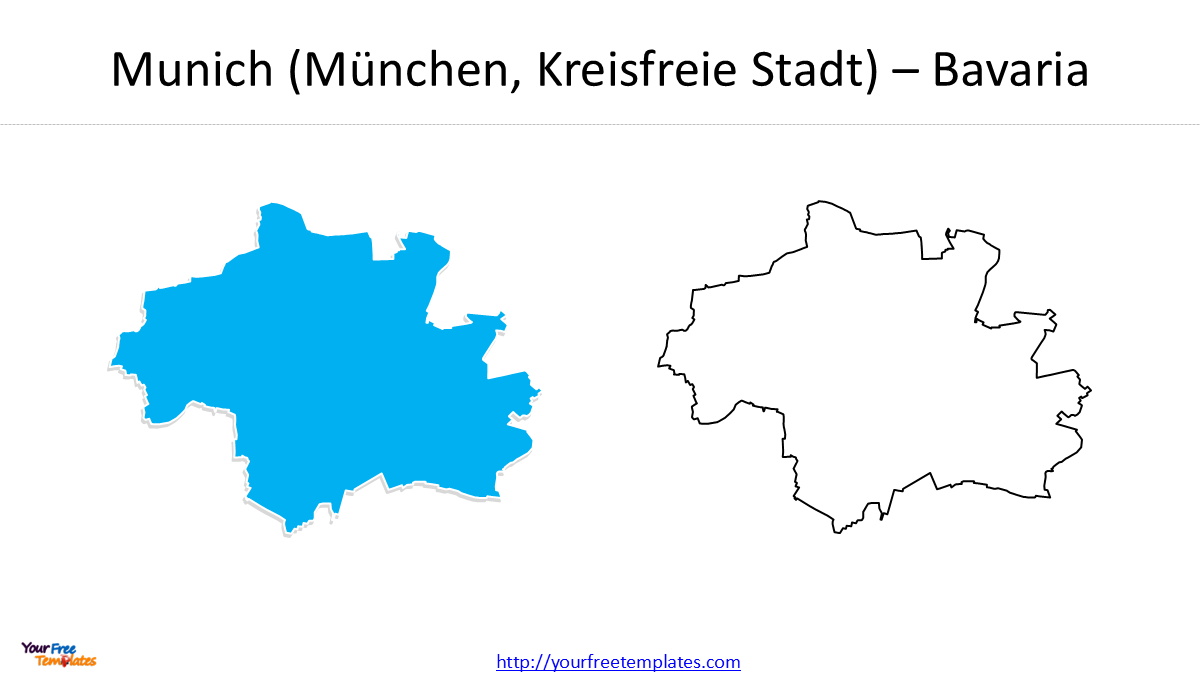
2. Munich (München, Kreisfreie Stadt) – Bavaria
GDP per Capita: Approximately €105,000
Federal State: Bavaria (Bayern)
Population: Approximately 1.5 million
Munich is Germany’s second-richest urban district and the wealthiest major city in Germany. The city is a global center for automotive engineering, technology, insurance, and publishing.
Why High GDP per Capita:
-
BMW Headquarters: BMW Group is headquartered in Munich, with its main factory producing engines, the 3 Series, 4 Series, and electric i-series vehicles. BMW’s R&D, design, and executive functions are concentrated in the city.
-
Siemens & Electronics: Siemens AG, one of Europe’s largest industrial conglomerates (electrification, automation, digitalization), is headquartered in Munich.
-
Technology & Startups: Munich is Germany’s leading tech hub, often called “Isar Valley” (after the local river, in imitation of Silicon Valley). The city hosts Google’s Germany HQ, Microsoft’s Germany HQ, IBM, Infineon, and hundreds of software and AI startups.
-
Insurance & Finance: Munich is a global insurance hub, hosting the headquarters of Allianz (one of the world’s largest insurers), Munich Re (one of the world’s largest reinsurers), and numerous other financial institutions.
-
Aerospace & Defense: Airbus Defence and Space has significant operations in Munich (Ottobrunn), and the city hosts numerous aerospace and defense suppliers.
-
Publishing & Media: Munich is Germany’s media capital, after Berlin, hosting the headquarters of Burda Media, ProSiebenSat.1, and numerous publishing houses.
-
High-Income Residents: Munich has the highest concentration of millionaires and high-net-worth individuals of any German city, further elevating per capita statistics.
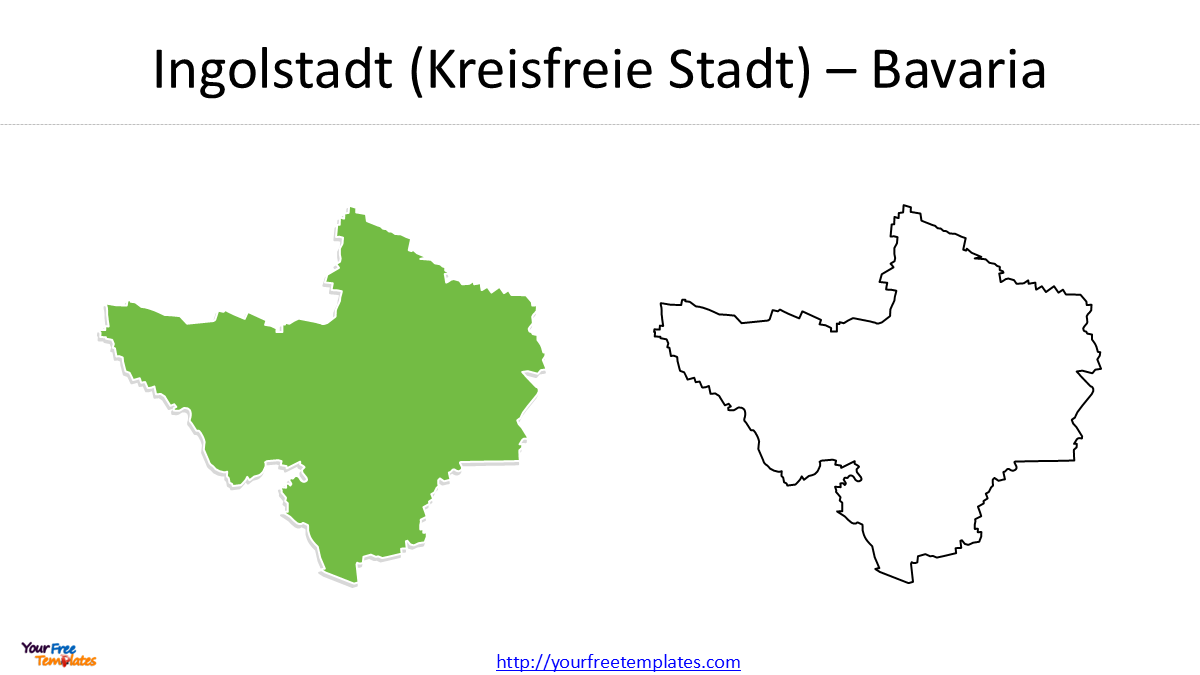
3. Ingolstadt (Kreisfreie Stadt) – Bavaria
GDP per Capita: Approximately €98,000
Federal State: Bavaria (Bayern)
Population: Approximately 140,000
Ingolstadt is Germany’s third-richest district, driven entirely by the Audi automotive group. Like Wolfsburg, Ingolstadt is a company town built around a premium automobile manufacturer.
Why High GDP per Capita:
-
Audi Headquarters: Audi AG, the premium automotive brand of the Volkswagen Group, is headquartered in Ingolstadt. The main Audi plant employs approximately 45,000 workers, producing the A3, A4, A5, Q2, Q5, and electric e-tron models.
-
High-Margin Automotive: Audi’s premium positioning means higher value per vehicle than mass-market brands (though below Porsche and luxury marques).
-
Engineering & R&D: Audi’s technical development, design studios, and testing facilities are concentrated in Ingolstadt, employing thousands of engineers and designers.
-
Low Population Base: Like Wolfsburg, Ingolstadt’s relatively small population (140,000) means that the massive GDP generated by Audi is divided among fewer residents, producing an exceptionally high per capita figure.
-
Suppliers & Service Providers: A dense network of automotive suppliers (Bosch, Continental, ZF, Webasto) and service providers augment the local economy.
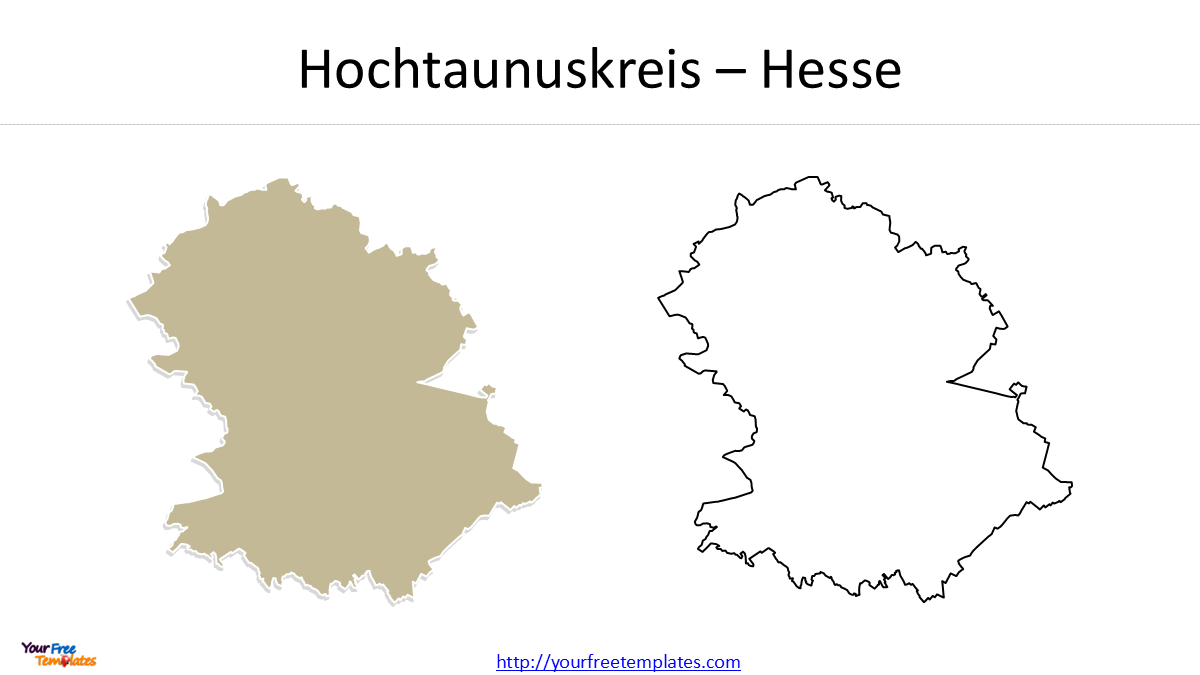
4. Hochtaunuskreis – Hesse
GDP per Capita: Approximately €92,000
Federal State: Hesse (Hessen)
Population: Approximately 240,000
The Hochtaunuskreis is a rural district (Landkreis) immediately north of Frankfurt, encompassing affluent suburbs including Bad Homburg, Oberursel, Friedrichsdorf, and Kronberg. It is Germany’s richest rural district, driven by proximity to Frankfurt’s financial center and high-income commuter residents.
Why High GDP per Capita:
-
Frankfurt Commuter Belt: The Hochtaunuskreis is part of the Frankfurt metropolitan region. Many residents work in Frankfurt’s financial, legal, and professional services sectors, earning high salaries while living in the district.
-
Highest-Income Commuters: The district consistently ranks as having Germany’s highest average incomes, driven by executives, bankers, lawyers, and consultants who commute to Frankfurt.
-
Pharmaceutical Presence: Bad Homburg is the headquarters of Fresenius (one of the world’s largest healthcare and pharmaceutical companies, specializing in dialysis products, medical devices, and hospital management).
-
Technology & Services: The district hosts numerous technology, consulting, and professional services companies, attracted by the high-quality residential environment and proximity to Frankfurt.
-
Wealthy Residential Base: The district’s towns (Bad Homburg, Königstein, Kronberg) are among Germany’s most expensive residential areas, with high property values and concentrations of wealth.
-
**Saxony’s GDP per capita is approximately €35,000, illustrating the stark east-west economic divide.)
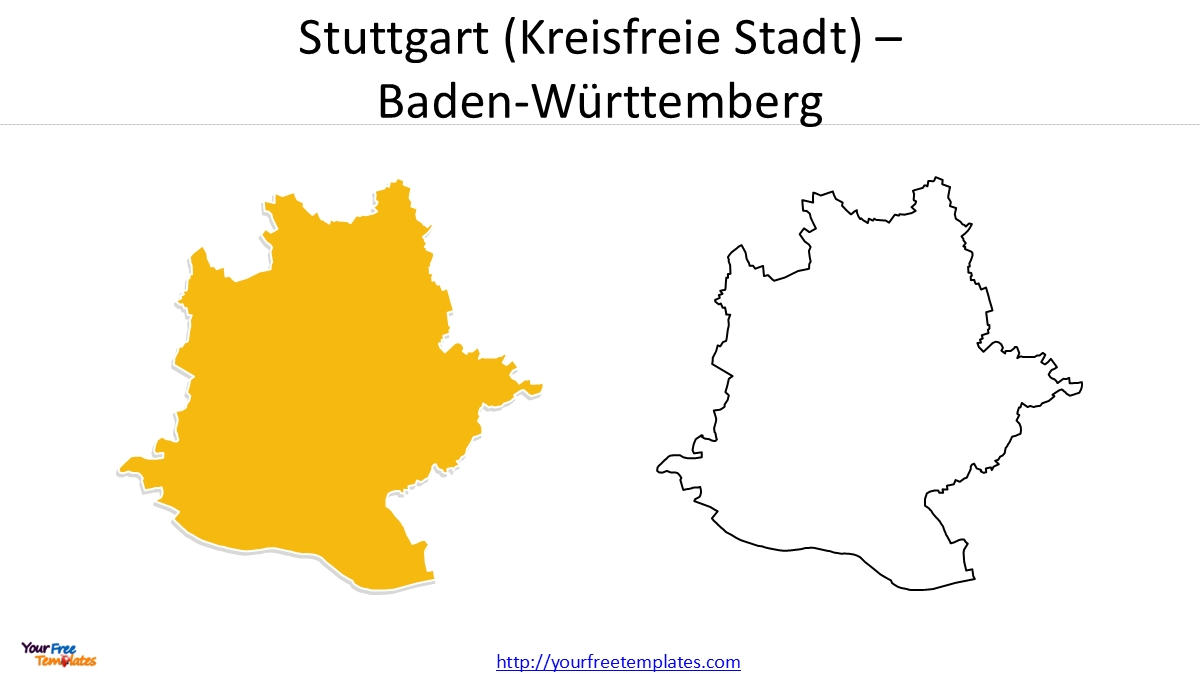
5. Stuttgart (Kreisfreie Stadt) – Baden-Württemberg
GDP per Capita: Approximately €89,000
Federal State: Baden-Württemberg
Population: Approximately 630,000
Stuttgart is Germany’s fifth-richest urban district and the capital of Baden-Württemberg. The city is the historical heart of the German automotive industry, home to Mercedes-Benz Group and Porsche.
Why High GDP per Capita:
-
Mercedes-Benz Group Headquarters: Mercedes-Benz Group AG (formerly Daimler AG) is headquartered in Stuttgart (Untertürkheim district). The company’s main factory produces engines, transmissions, and electric drivetrains, as well as final assembly for S-Class, E-Class, and several other models.
-
Porsche Headquarters: Porsche AG is headquartered in Stuttgart (Zuffenhausen district), with its main plant producing the iconic 911, 718 Boxster/Cayman, and Taycan electric sports cars.
-
Automotive Supply Chain: The Stuttgart region is the epicenter of the German automotive supply chain, hosting global suppliers including Bosch (headquartered in nearby Gerlingen), Mahle, Behr, and hundreds of specialized engineering firms.
-
High-Value Engineering: The district’s economy is characterized by high-value mechanical engineering, precision manufacturing, and industrial automation, with high wages and high productivity.
-
Research & Innovation: Stuttgart is home to the Fraunhofer Institute for Industrial Engineering, the University of Stuttgart (strong in automotive engineering and mechatronics), and numerous industrial research centers.
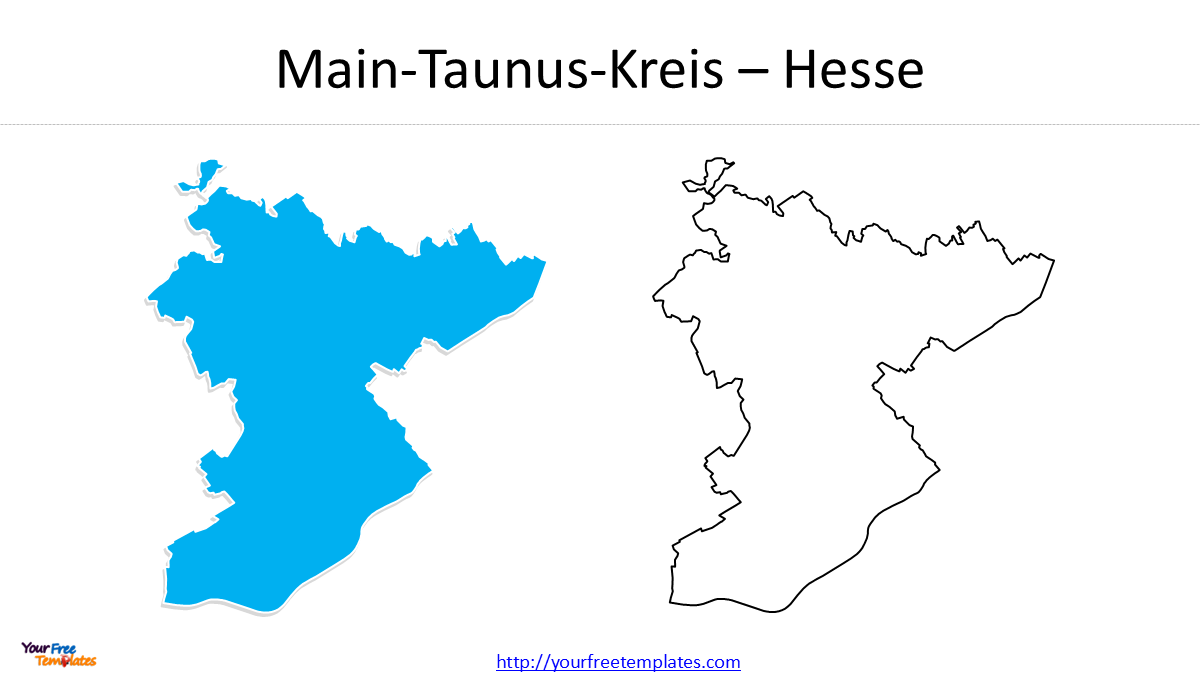
6. Main-Taunus-Kreis – Hesse
GDP per Capita: Approximately €85,000
Federal State: Hesse (Hessen)
Population: Approximately 240,000
The Main-Taunus-Kreis is a rural district immediately west of Frankfurt, encompassing suburbs including Hofheim, Kelkheim, Bad Soden, and Eschborn. Like the Hochtaunuskreis, its wealth is driven by proximity to Frankfurt and a concentration of corporate headquarters.
Why High GDP per Capita:
-
Frankfurt Commuter Belt: The district is part of the Frankfurt metropolitan region. Many high-income residents work in Frankfurt’s financial and professional services sectors.
-
Eschborn Corporate Hub: Eschborn (within the district) is a major corporate suburb of Frankfurt, hosting the German or European headquarters of numerous international companies, including Deutsche Börse (German Stock Exchange) data center, Vodafone Germany, and many financial services firms.
-
High-Income Residents: The district’s municipalities (Bad Soden, Hofheim, Kelkheim) are among Germany’s wealthiest residential areas, with high property values and concentrations of executives.
-
Proximity to Frankfurt Airport: The district borders Frankfurt Airport, making it attractive for aviation logistics, cargo services, and corporate aviation.
-
Consulting & Professional Services: The district hosts numerous management consulting, law, and accounting firms serving Frankfurt’s corporate clients.
7. Starnberg (Landkreis) – Bavaria
GDP per Capita: Approximately €83,000
Federal State: Bavaria (Bayern)
Population: Approximately 135,000
The Starnberg district is a rural district immediately south-west of Munich, encompassing the towns of Starnberg, Gauting, Gilching, and others along the western shore of Lake Starnberg. It is Germany’s wealthiest district by disposable income (rather than GDP per capita), driven entirely by high-income commuters to Munich.

Why High GDP per Capita:
-
Munich Commuter Belt: Starnberg is part of the Munich metropolitan region. The S-Bahn (commuter rail) connects the district to Munich city center in 20-30 minutes. Many residents work in Munich’s high-paying automotive, tech, finance, and professional services sectors.
-
Lake Starnberg (Starnberger See) Wealth: The district’s location on Lake Starnberg—one of Germany’s most exclusive residential areas—attracts wealthy families, executives, entrepreneurs, and celebrities. The lakeside villas of Starnberg, Berg, and Feldafing are among Germany’s most expensive properties.
-
Highest Disposable Income: While GDP per capita is very high, Starnberg is best known for having Germany’s highest disposable income per capita (income after taxes and transfers), reflecting the concentration of high-wage commuters.
-
Lifestyle & Amenities: The district’s high-quality environment (lake access, proximity to the Alps, low crime, excellent schools) attracts high-income residents who work in Munich but live in Starnberg.
-
Service Economy: The district has a service economy serving wealthy residents, including private banking, wealth management, luxury retail, healthcare, and hospitality.
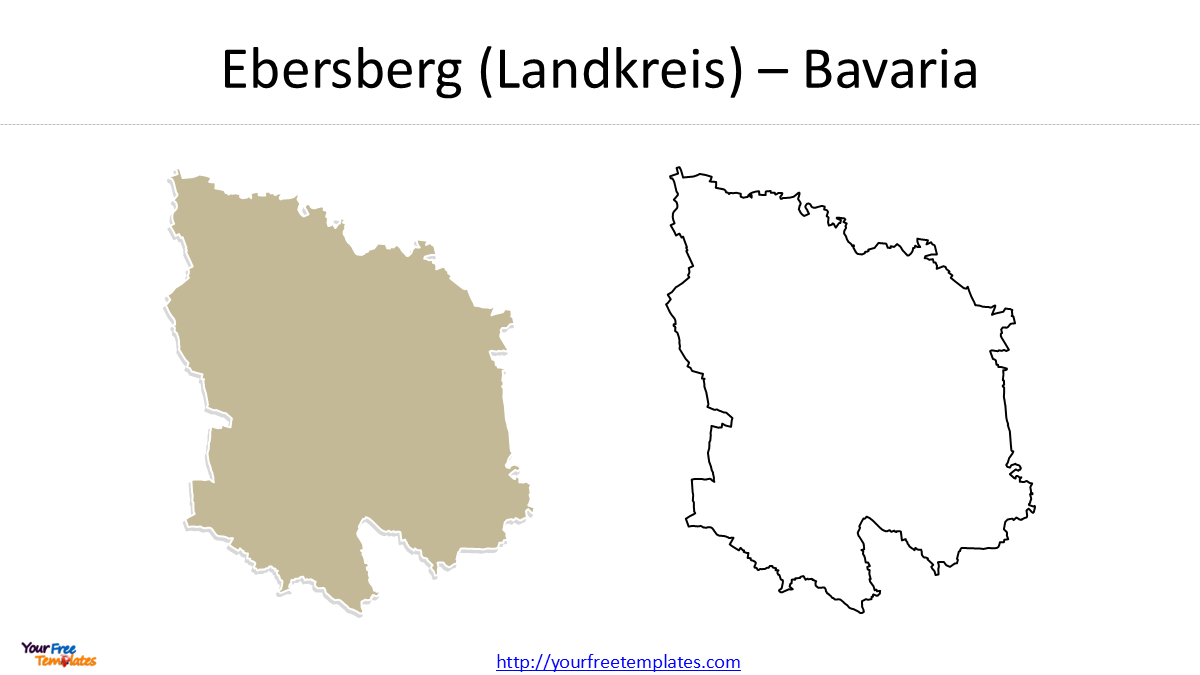
8. Ebersberg (Landkreis) – Bavaria
GDP per Capita: Approximately €81,000
Federal State: Bavaria (Bayern)
Population: Approximately 145,000
The Ebersberg district is a rural district east of Munich, encompassing the towns of Ebersberg, Vaterstetten, Poing, and others. Like Starnberg, its wealth is driven by high-income commuters to Munich.
Why High GDP per Capita:
-
Munich Commuter Belt: Ebersberg is part of the Munich metropolitan region. The S-Bahn connects Vaterstetten (the district’s most populous municipality) to Munich’s Ostbahnhof in approximately 20 minutes. Many residents commute to high-paying jobs in Munich’s automotive, tech, and professional services sectors.
-
Young & Affluent Population: Ebersberg has a younger, more family-oriented demographic than Starnberg, with many dual-income professional couples and families.
-
High Property Values: The district’s proximity to Munich, good schools, and high-quality environment have driven property values to among the highest in Germany.
-
Service Economy: The district has a growing service economy, including retail, healthcare, education, and professional services serving the residential population.
-
Business Parks: Vaterstetten and Poing have attracted technology and service companies seeking proximity to Munich with lower costs (though “lower” is relative—costs remain high).
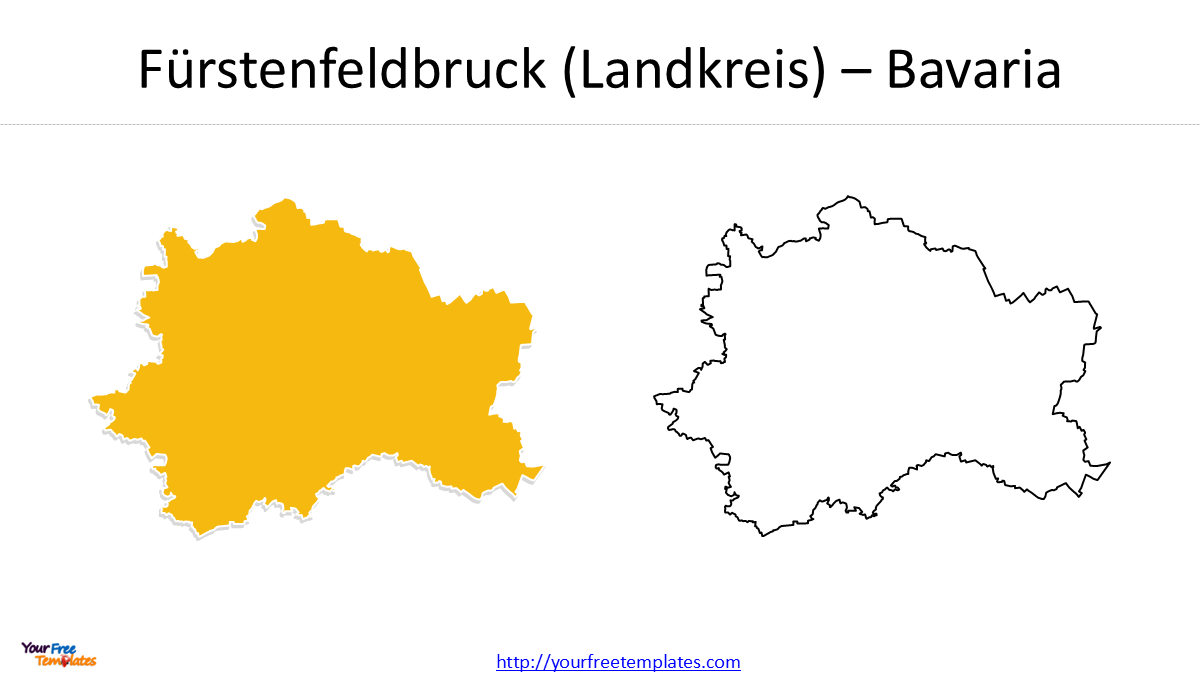
9. Fürstenfeldbruck (Landkreis) – Bavaria
GDP per Capita: Approximately €79,000
Federal State: Bavaria (Bayern)
Population: Approximately 220,000
The Fürstenfeldbruck district is a rural district immediately west of Munich, encompassing the towns of Fürstenfeldbruck, Germering, Olching, and others. It is part of the dense Munich commuter belt.
Why High GDP per Capita:
-
Munich Commuter Belt: Fürstenfeldbruck is part of the Munich metropolitan region. The S-Bahn connects Germering and Fürstenfeldbruck to Munich city center in 25-35 minutes. Many residents commute to high-paying jobs in Munich.
-
Aerospace & Defense: The district has a historical connection to the German air force (Fürstenfeldbruck Air Base). While the base’s role has diminished, the district retains aerospace and defense technology companies.
-
Logistics Hub: The district’s proximity to Munich and its position on the A8 and A99 highways (Munich ring road) make it a location for logistics centers serving the Munich region.
-
High-Income Commuters: Like other Munich suburbs, Fürstenfeldbruck has a high concentration of professionals, managers, and executives who work in Munich but live in the district for more space, better schools, and lower costs than central Munich.
-
Diversified Economy: The district has a more diversified economy than pure commuter districts, including manufacturing (machinery, electronics, medical devices), services, and retail.
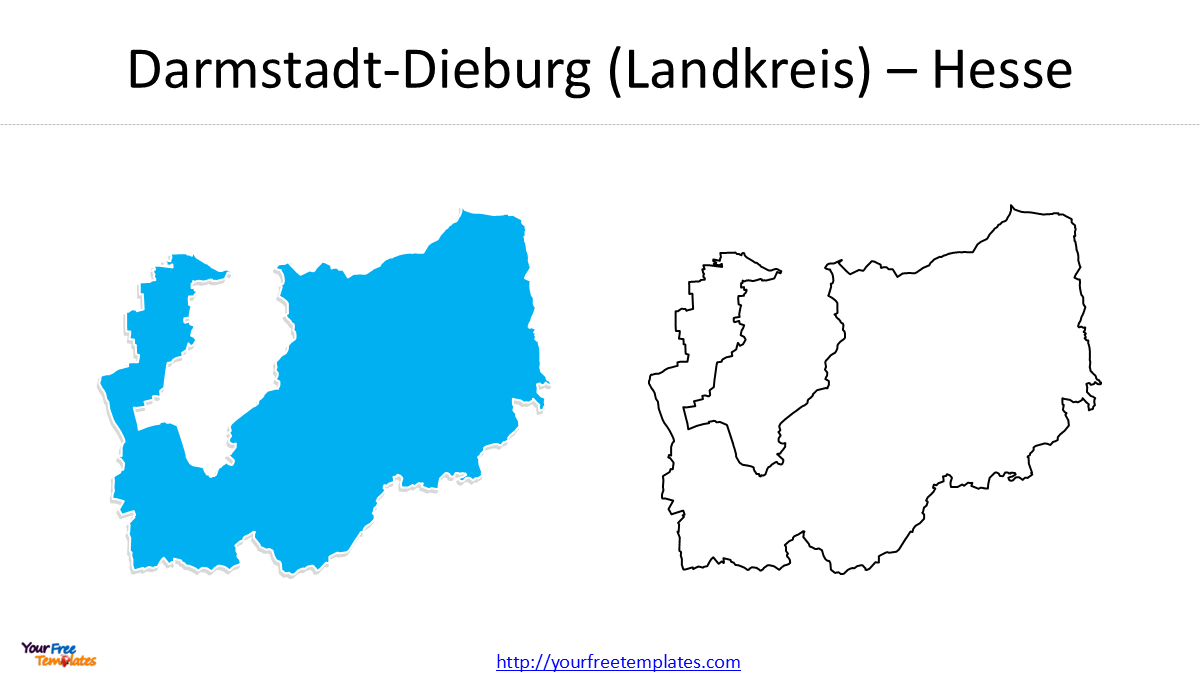
10. Darmstadt-Dieburg (Landkreis) – Hesse
GDP per Capita: Approximately €77,000
Federal State: Hesse (Hessen)
Population: Approximately 300,000
The Darmstadt-Dieburg district is a rural district immediately south of Frankfurt, encompassing the city of Darmstadt and surrounding towns. It is unique among top districts for having a strong local technology and research economy rather than being a pure commuter belt.
Why High GDP per Capita:
-
Darmstadt Technology Hub: The city of Darmstadt (within the district) is a major German technology and research hub, often called the “City of Science.” The district hosts three Fraunhofer Institutes, two Leibniz Institutes, the European Space Agency’s European Space Operations Centre (ESOC, which controls ESA satellites and spacecraft), and EUMETSAT (European Organization for the Exploitation of Meteorological Satellites).
-
Merck KGaA Headquarters: Merck, one of the world’s oldest pharmaceutical and chemical companies (founded 1668), is headquartered in Darmstadt. Merck’s operations (healthcare, life sciences, electronics) generate high-value employment.
-
Software & IT: Darmstadt is a major German IT and software hub, hosting the German headquarters of numerous software companies and a vibrant startup ecosystem.
-
Darmstadt University (TU Darmstadt): The Technical University of Darmstadt is one of Germany’s leading engineering universities, particularly strong in computer science, electrical engineering, mechanical engineering, and physics. The university feeds talent into the local technology economy.
-
Frankfurt Proximity: The district’s northern municipalities (Griesheim, Weiterstadt) are within the Frankfurt commuter belt, with high-income residents working in Frankfurt’s financial and professional services sectors.
-
Diversified High-Value Economy: Unlike pure commuter districts (Starnberg, Ebersberg, Main-Taunus), Darmstadt-Dieburg has a locally anchored technology and research economy, making it less dependent on commuting and more resilient.
Comparative Analysis: Key Takeaways from the German Landkreise GDP Ranking
| Rank | District | Federal State | GDP per Capita (€) | Primary Economic Driver |
|---|---|---|---|---|
| 1 | Wolfsburg | Lower Saxony | €182,000 | Volkswagen headquarters & plant |
| 2 | Munich (City) | Bavaria | €105,000 | BMW, Siemens, tech, insurance |
| 3 | Ingolstadt | Bavaria | €98,000 | Audi headquarters & plant |
| 4 | Hochtaunuskreis | Hesse | €92,000 | Frankfurt commuter belt, Fresenius |
| 5 | Stuttgart (City) | Baden-Württemberg | €89,000 | Mercedes-Benz, Porsche, Bosch |
| 6 | Main-Taunus-Kreis | Hesse | €85,000 | Frankfurt commuter belt, Eschborn corporate |
| 7 | Starnberg | Bavaria | €83,000 | Munich commuter belt (Lake Starnberg) |
| 8 | Ebersberg | Bavaria | €81,000 | Munich commuter belt |
| 9 | Fürstenfeldbruck | Bavaria | €79,000 | Munich commuter belt |
| 10 | Darmstadt-Dieburg | Hesse | €77,000 | Merck, space (ESA), IT, research |
Key Observations on the Richest Districts in Germany:
-
Automotive Dominance: Three of the top five districts (Wolfsburg, Ingolstadt, Stuttgart) are automotive company towns. Volkswagen, Audi, Mercedes-Benz, and Porsche anchor hyper-productive local economies with per capita GDP far exceeding the national average.
-
The Munich Commuter Belt: Four of the top ten districts (Munich city, Starnberg, Ebersberg, Fürstenfeldbruck) are part of the Munich metropolitan area. The first two are Bavarian districts surrounding Munich, illustrating how high-income commuters raise per capita metrics even when they work in the core city.
-
Frankfurt Periphery: Three of the top ten districts (Hochtaunuskreis, Main-Taunus-Kreis, Darmstadt-Dieburg) are in the Frankfurt metropolitan area, reflecting Frankfurt’s status as Germany’s financial capital and its wealthy suburban belt.
-
East-West Divide: All ten districts are in former West Germany (Lower Saxony, Bavaria, Hesse, Baden-Württemberg). No district from former East Germany (including Berlin) ranks in the top ten, reflecting the persistent economic divide three decades after reunification.
-
Company Towns vs. Commuter Belts: The ranking reveals two distinct models of high GDP per capita: company towns (Wolfsburg, Ingolstadt) where a single corporation generates extraordinary local GDP relative to a small population, and commuter belts (Hochtaunus, Main-Taunus, Starnberg, Ebersberg, Fürstenfeldbruck) where high-income residents work in a nearby major city (Frankfurt or Munich).
-
The “Starnberg Paradox”: Starnberg has Germany’s highest disposable income (income after taxes and transfers) but only the seventh-highest GDP per capita. This is because GDP is measured where people work (often Munich), not where they live (Starnberg). Many Starnberg residents work in Munich, so their GDP contribution is recorded in Munich, not Starnberg. Starnberg’s high disposable income reflects its wealthy residential base, not local production.
-
Darmstadt-Dieburg as an Anomaly: Darmstadt-Dieburg is the only top-ten district that is neither a company town nor a pure commuter belt. Its high GDP per capita is driven by a locally anchored technology, research, and pharmaceutical economy (Merck, ESA, Fraunhofer, TU Darmstadt), making it a more diversified and resilient model of high per capita wealth.
Download the PowerPoint Slides
This blog post is accompanied by an 11-slide PowerPoint deck:
-
Slide 1: National map of Germany with Landkreis-level boundaries for all ten high-GDP districts highlighted
-
Slides 2–11: Enlarged district-level maps for Wolfsburg, Munich (City), Ingolstadt, Hochtaunuskreis, Stuttgart (City), Main-Taunus-Kreis, Starnberg, Ebersberg, Fürstenfeldbruck, and Darmstadt-Dieburg
These slides are fully editable, allowing you to add GDP per capita data, economic annotations, or color coding based on productivity levels. Visit yourfreetemplates.com to download the complete deck.
Looking for Premium maps, please visit our affiliate site: https://editablemaps.com/ or https://ofomaps.com/
Size:380K
Type: PPTX
Top 10 Highest GDP per Capita German Districts Template
Click the link to download it.
Aspect Ratio: Widescreen 16:9
Click the green button to download it.
Download the 16:9 Template