

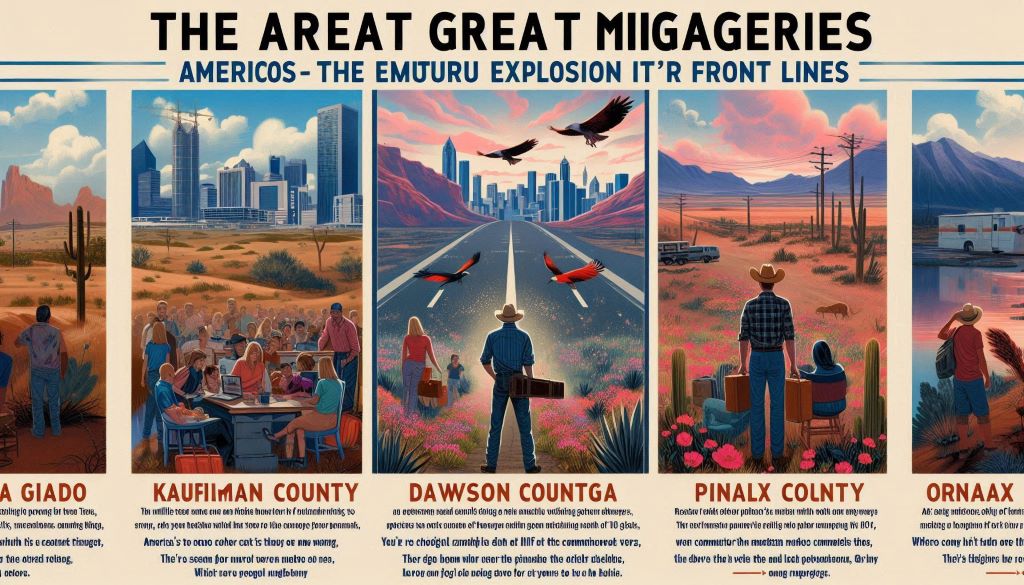
Look at any map of America’s population shift over the last five years, and one pattern is unmistakable: a massive arrow pointing inward, toward the Sun Belt. This isn’t just about birth rates or international arrivals—the dominant force is domestic migration. Americans are voting with their U-Hauls, leaving expensive coastal metros and crowded suburbs in search of something fundamentally different: space they can afford and a lifestyle that doesn’t require a Silicon Valley salary.
In Episode 1 of our Great Migration series, we trace this powerful trend to its front lines—three counties where the exurban explosion isn’t a future prediction, but a present-day reality. We’re talking about families trading cramped apartments for Texas backyards, remote workers choosing mountain views over Atlanta traffic, and Phoenix commuters finding value beyond the 101 Loop. Welcome to Kaufman County, Texas; Dawson County, Georgia; and Pinal County, Arizona—ground zero for America’s great move outward.
At the end of this post, you can download our The Exurban Explosion boundary PowerPoint template to fit your purpose. As the same diagram PowerPoint template series, you can also find our Top 12 Most Populous Countries, most dangerous cities in the US, Top 10 U.S. Cities with the Highest Violent Crime Rate, US Consolidated City County
- 18 Fastest Growing US Counties – Summary
- Episode 1 –The Exurban Explosion, Kaufman County, Texas; Dawson County, Georgia; and Pinal County, Arizona
- Episode 2 – Commuter Corridors US, Liberty County, Texas; Rockwall County, Texas; and Jackson County, Georgia
- Episode 3 – The Southwest Density Drivers, Comal, Texas; Ellis, Texas; and Osceola, Florida
- Episode 4 – Amenity Migration Hotspots,Brunswick County, North Carolina; Jasper County, South Carolina; and Madison County, Idaho
- Episode 5 – Highest Numeric Population Growth,Harris County, Texas; Maricopa County, Arizona; and Miami-Dade County, Florida
- Episode 6 – Tech Sprawl,Collin County, Texas; Clark County, Nevada; and Polk County, Florida
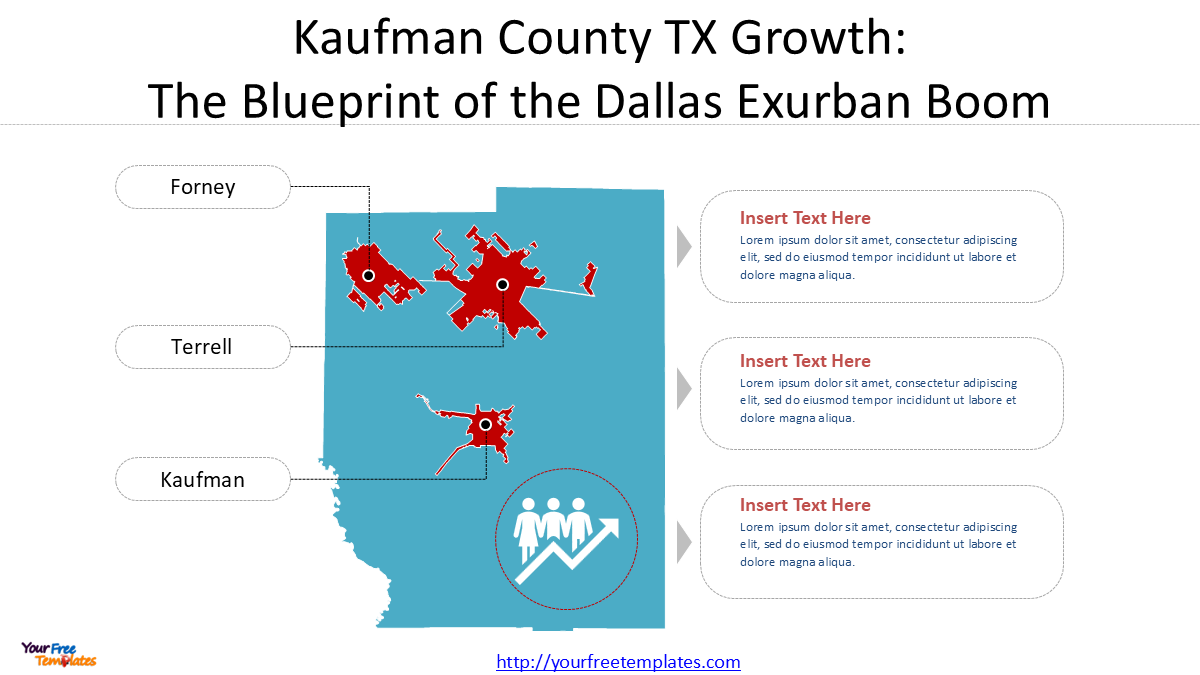
Kaufman County TX Growth: The Blueprint of the Dallas Exurban Boom
If you want to understand modern domestic migration, look 30 miles east of Dallas. Kaufman County isn’t just growing—it’s evolving at warp speed, with a 6.0% annual growth rate that places it among America’s most dynamic counties. But what’s bringing thousands of families here each year?
Key Cities Driving Growth:
-
Forney: The undisputed growth engine, drawing commuters from Dallas.
-
Terrell: Developing rapidly with new industrial and residential projects.
-
Kaufman: The historic county seat, seeing revitalized interest and new development.
The Forney, TX Phenomenon: More Than Just a Commuter Town
A decade ago, Forney was a quiet community of 15,000. Today, it’s pushing 35,000 and shows no signs of slowing. This isn’t accidental growth—it’s a direct response to Dallas’s housing crisis. When a 2,000-square-foot home in Plano costs $600,000+ but the same house in Forney goes for $400,000, the decision becomes painfully clear for young families.
“Five years ago, we had one high school. Now we’re building our third,” says Maria Rodriguez, a longtime Forney real estate agent. “The Forney TX population boom isn’t slowing down because the fundamentals haven’t changed—Dallas keeps adding jobs, and people need somewhere affordable to live.”
The Infrastructure Race: Building a City in Real-Time
What visitors notice immediately are the construction cranes—not just for homes, but for schools, water treatment plants, and road expansions. Kaufman County added three new schools in the past two years alone. Highway 80 expansions have helped, but the reality remains: thousands of new residents all need to reach Dallas by 9 AM.
This exurban boom reveals a critical truth about modern domestic migration: people aren’t just buying houses, they’re investing in communities being built around them. Master-planned developments like Trinity Falls aren’t just subdivisions—they’re creating town centers with parks, pools, and shopping districts where cornfields stood just five years ago.
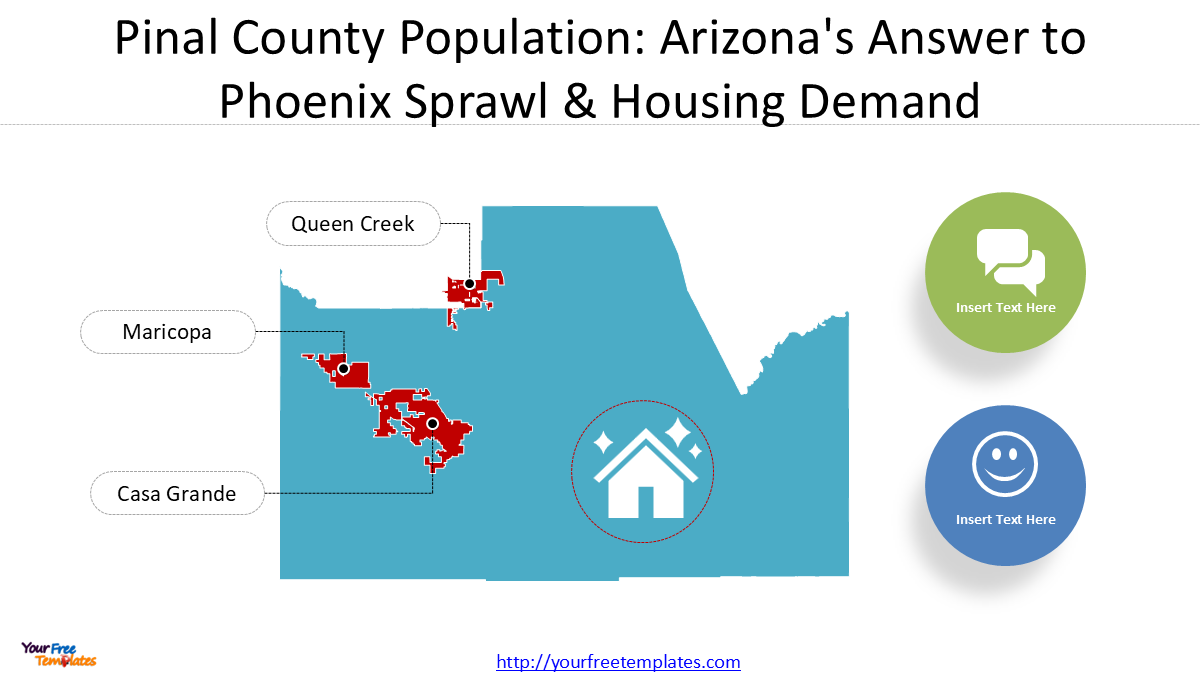
Pinal County Population: Arizona’s Answer to Phoenix Sprawl & Housing Demand
South of Phoenix, a different kind of migration story unfolds. Pinal County’s consistent 4.5% annual growth represents more than just affordable housing Phoenix seekers—it’s becoming Arizona’s next major economic corridor.
Three Cities, Three Migration Stories
Pinal County’s growth comes in distinct flavors:
-
Queen Creek (Pinal portion): The premium choice, attracting California transplants with top-rated schools and communities that feel more like Orange County than Arizona desert.
-
Maricopa: The value proposition. Known for maximum square footage per dollar, it’s become a haven for teachers, first responders, and service workers priced out of Phoenix proper.
-
Casa Grande: The jobs magnet. The Casa Grande AZ development story centers on industrial growth, with companies like Lucid Motors investing billions and creating thousands of jobs that attract workers from across the Southwest.
The Water Reality: Growth’s Ultimate Limiter
No discussion of Arizona growth is complete without addressing water. Pinal County sits in the Colorado River basin crisis zone, making every new development approval a calculated decision.
“We’ve shifted from approving purely residential projects to prioritizing developments with water recycling built in,” explains Carlos Mendez, a Pinal County planning official. “The Phoenix sprawl can’t continue unchecked—sustainability isn’t a buzzword here; it’s a survival requirement.”
This reality shapes migration patterns. Families aren’t just comparing home prices—they’re asking about 100-year water assurance plans and drought-resistant landscaping requirements before they sign closing papers.
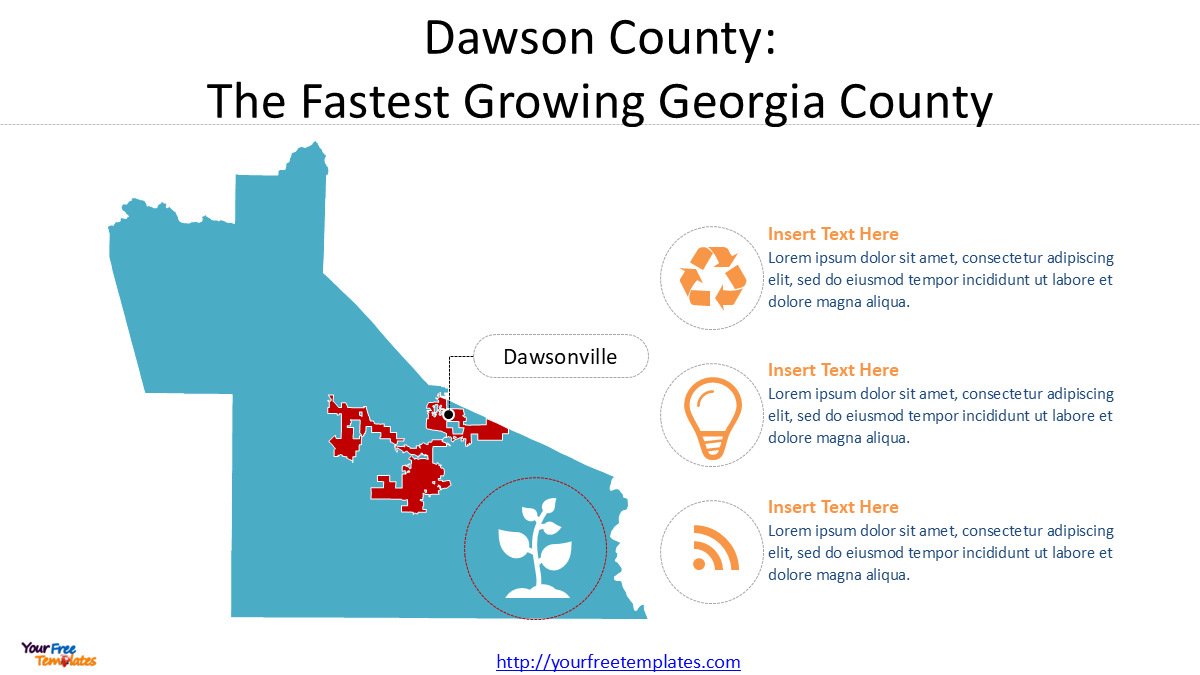
Dawson County: The Fastest Growing Georgia County Redefines “Atlanta Adjacent”
Nestled in the Appalachian foothills, Dawson County represents migration’s lifestyle dimension. With a 6.4% annual growth rate, it’s not just one of Georgia’s fastest-growing counties—it’s redefining what “Atlanta-adjacent” means in the remote work era.
Key Cities Driving Growth:
-
Dawsonville: The county’s largest municipality and primary growth driver.
-
Silver City (Unincorporated): Experiencing significant residential development.
-
Big Canoe (Unincorporated): A popular master-planned community attracting retirees and second-home owners, contributing to high-income migration.
Dawsonville’s Charm Offensive
While other exurbs grow with generic subdivisions, Dawsonville maintains its character. Yes, there are new developments, but they’re nestled among rolling hills rather than bulldozing them. The downtown still feels like a mountain town even as new shopping centers appear on the outskirts.
The Remote Work Migration
“I kept my Atlanta salary but traded my quarter-acre lot for five acres with a view,” says software engineer David Chen, who relocated from Alpharetta. “My commute went from 45 minutes of traffic to a 30-second walk to my home office. That’s the calculus that’s driving the Dawsonville GA growth—we’re not just moving for cheaper housing, but for better living.”
This represents a fundamental shift in domestic migration patterns. The pandemic proved many jobs could be done remotely, and workers are choosing their locations based on lifestyle rather than proximity to a physical office.
The Preservation Paradox
Growth brings inevitable tension. Longtime residents worry about losing the rural character that makes Dawson County special. County commissioners face constant balancing acts: approve new developments to accommodate growth, or restrict building to preserve forests and streams?
“The challenge isn’t whether to grow,” says County Commissioner Sarah Johnson, “but how to grow smart. We’re requiring larger lot sizes in certain areas and mandating green space preservation in new developments. We want to welcome new residents without sacrificing what drew them here in the first place.”
The Common Thread: Why Domestic Migration Isn’t Slowing Down
These three counties—separated by thousands of miles—tell a unified story about America’s population shift:
-
The Affordability Math Still Works: Even with rising prices in these exurbs, the gap between urban core and outlying areas remains substantial. For families, that difference represents college funds, retirement savings, or simply financial breathing room.
-
Hybrid Work is Here to Stay: The 45-minute commute becomes tolerable when it’s only required twice a week. Companies have largely accepted hybrid models, giving employees geographic flexibility they haven’t had in generations.
-
Self-Sustaining Communities Emerge: These aren’t just bedroom communities anymore. Each is developing its own economic identity—Forney with its retail and light industrial, Casa Grande with manufacturing, Dawsonville with tourism and remote work hubs.
-
Generation X and Millennials Are Driving It: These aren’t just retirees moving south. The data shows families with children—people in their 30s and 40s—are leading this migration, seeking better schools and more space for their kids.
The Reality Check: What Migration Brochures Don’t Mention
Before you start packing boxes, consider what these growth stories don’t always highlight:
-
Commutes Are Real: That “easy access” to Dallas/Atlanta/Phoenix assumes ideal conditions. Rush hour can double travel times, and infrastructure often lags behind population growth.
-
Services Play Catch-Up: New schools are crowded from day one. Doctor’s appointments book weeks out. You might get a beautiful new house before the neighborhood gets its promised park or library.
-
Character Changes Fast: That charming small town atmosphere that drew you in? It might be gone in five years as growth accelerates. Many exurbs struggle to maintain their identity amid rapid development.
Looking Ahead: Sustainable Growth or Growing Pains?
The exurban explosion shows no signs of slowing. As housing costs in major metros continue to outpace wages, the push outward will only intensify. The counties that thrive won’t just be those with cheap land—they’ll be the ones that manage growth intelligently, preserving what makes them special while building the infrastructure for their future.
Kaufman, Pinal, and Dawson Counties represent three successful models, but each faces unique challenges: water in Arizona, traffic in Texas, preservation in Georgia. Their ability to solve these problems will determine whether today’s boomtowns become tomorrow’s sustainable communities or cautionary tales about growing too fast.
These three counties – Kaufman, Dawson, and Pinal – illustrate perfectly how the quest for affordability, quality of life, and new economic opportunities is reshaping the American demographic map. Join us in Episode 2 as we explore another trio of counties experiencing their own unique growth stories!
Looking for Premium maps, please visit our affiliate site: https://editablemaps.com/ or https://ofomaps.com/
Size:148K
Type: PPTX
Episode 1:The Exurban Explosion Template
Click the link to download it.
Aspect Ratio: Widescreen 16:9
Click the green button to download it.
Download the 16:9 Template