


Choosing a country for your study abroad experience is a complex decision that goes beyond university rankings. This detailed guide breaks down the top 10 best countries to study in 2024, providing key insights into costs, popular fields, career outcomes, and potential challenges to help you make an informed choice.
-
🇺🇸 United States: The academic powerhouse, ideal for top-tier research and flexible programs, but with high costs and a competitive visa process.
-
🇬🇧 United Kingdom: Offers world-renowned, time-efficient degrees and strong post-study work opportunities, though living costs in cities like London are high.
-
🇨🇦 Canada: Known for its welcoming immigration policies, high quality of life, and clear pathways to permanent residency for graduates.
-
🇦🇺 Australia: Combines a laid-back lifestyle with excellent academic standards and strong post-study work rights in globally livable cities.
-
🇩🇪 Germany: A leader in engineering and tuition-free (or very low-cost) world-class education, with a strong job market for graduates.
-
🇳🇱 Netherlands: Features a huge selection of innovative English-taught programs in a progressive, English-friendly, and international environment.
-
🇨🇭 Switzerland: Home to elite universities and a high quality of life, particularly strong in hospitality, finance, and sciences, but with a high cost of living.
-
🇸🇬 Singapore: A dynamic, safe, and efficient Asian hub that serves as a gateway to the region’s growing markets, with a focus on business and technology.
-
🇸🇪 Sweden: A global leader in sustainability and innovation, offering excellent English-taught programs and a high standard of living.
-
🇯🇵 Japan: Provides a unique blend of cutting-edge technology and deep culture, with growing opportunities for international students.
1. United States: The Academic Powerhouse
The U.S. boasts an unparalleled number of prestigious universities and a flexible education system. It’s a top destination for ambitious students seeking cutting-edge research opportunities, a vibrant campus life, and strong career prospects in a dynamic market.
-
Annual Cost: $25,000 – $60,000+ (Tuition & Living)
-
Best Programs: Business Administration (MBA), Computer Science, Engineering, Data Science, Liberal Arts.
-
Key Student Demographics: China and India are the top sending countries, together constituting a significant majority of the international student body, followed by South Korea and Vietnam.
-
Post-Study Work Visa: Optional Practical Training (OPT), lasting 1 year (or 3 years for STEM fields). Transitioning to an H-1B work visa requires a lottery.
-
Job Prospects: Excellent, especially in tech, finance, and research. However, competition for visa-sponsored roles is intense.
-
Top Universities for International Students:
-
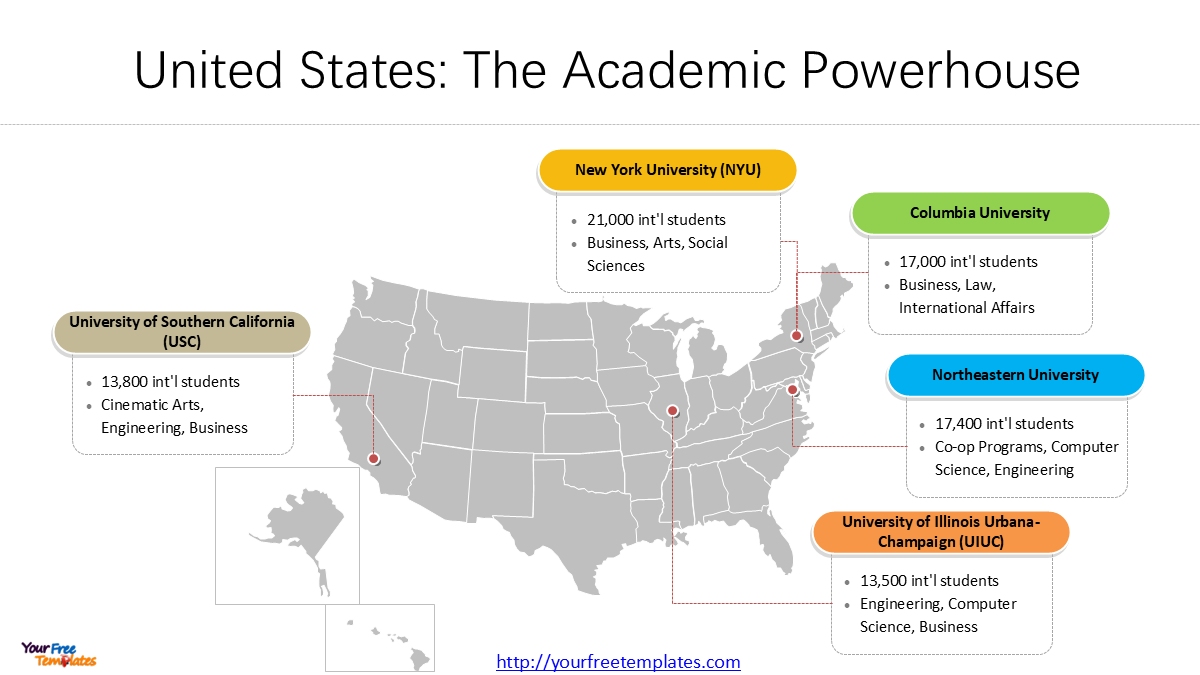
New York University (NYU): New York, NY | ~21,000* int’l students | Popular for: Business, Arts, Social Sciences.
-
Northeastern University: Boston, MA | ~17,400 int’l students | Popular for: Co-op Programs, Computer Science, Engineering.
-
Columbia University: New York, NY | ~17,000 int’l students | Popular for: Business, Law, International Affairs.
-
University of Southern California (USC): Los Angeles, CA | ~13,800 int’l students | Popular for: Cinematic Arts, Engineering, Business.
-
University of Illinois Urbana-Champaign (UIUC): Illinois | ~13,500 int’l students | Popular for: Engineering, Computer Science, Business.
-
-
Potential Risks: Very high cost, complex and uncertain visa process (H-1B lottery), potential political friction for students from specific countries.
- Build your map with template United States.
Note:The figure of “approximately 21,000 international students” at New York University (NYU) refers to the total number of degree-seeking international students across all of its schools, colleges, and campuses worldwide for a given academic year.
2. United Kingdom: Tradition and Excellence
Home to world-renowned institutions like Oxford and Cambridge, the UK offers a rigorous, respected academic tradition with shorter degree durations. Its rich history and cultural diversity, combined with reinstated post-study work rights, make it a compelling choice.
-
Annual Cost: $22,000 – $50,000+ (London is significantly more expensive)
-
Best Programs: Finance, Law, Creative Arts, Engineering, Humanities.
-
Key Student Demographics: China, India, and Nigeria are the largest sources of international students, with a strong presence from other EU and Commonwealth nations like Malaysia.
-
Post-Study Work Visa: Graduate Route visa, allowing 2 years (3 years for PhD graduates) to work freely.
-
Job Prospects: Strong in London’s global financial center and other major cities. Long-term settlement requires securing a skilled job after the visa expires.
-
Top Universities for International Students:
-
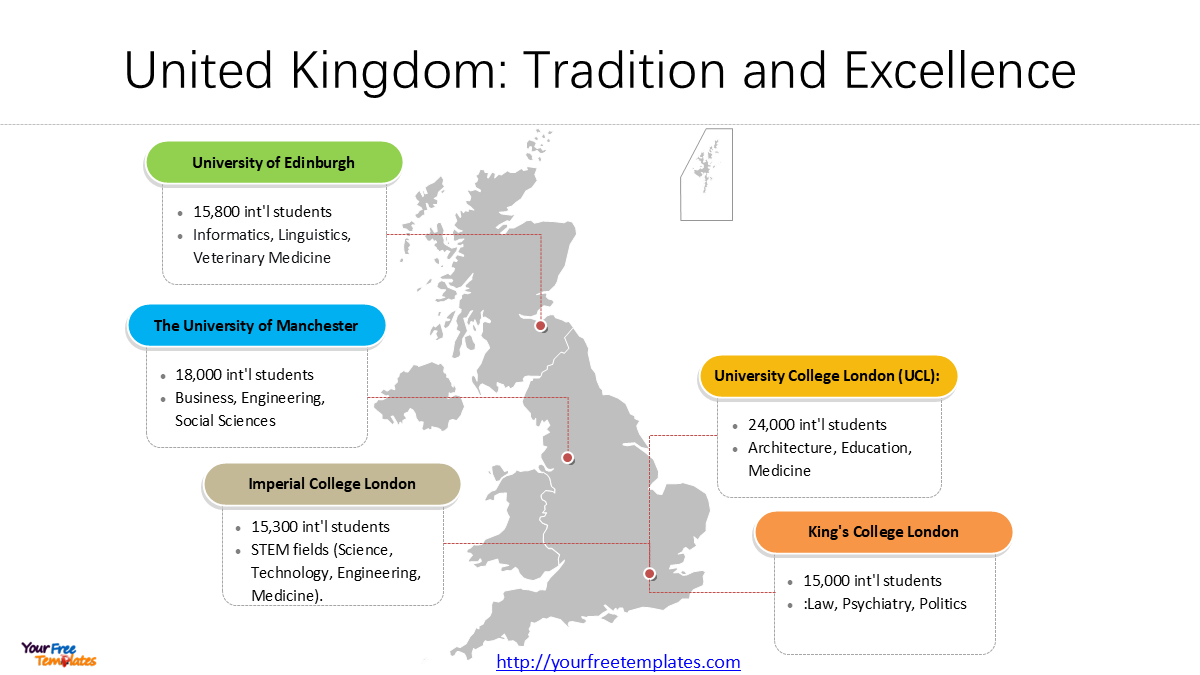
University College London (UCL): London | ~24,000 int’l students | Popular for: Architecture, Education, Medicine.
-
The University of Manchester: Manchester | ~18,000 int’l students | Popular for: Business, Engineering, Social Sciences.
-
University of Edinburgh: Edinburgh, Scotland | ~15,800 int’l students | Popular for: Informatics, Linguistics, Veterinary Medicine.
-
Imperial College London: London | ~15,300 int’l students | Popular for: STEM fields (Science, Technology, Engineering, Medicine).
-
King’s College London: London | ~15,000 int’l students | Popular for: Law, Psychiatry, Politics.
-
-
Potential Risks: High living costs, particularly in London; pressure to find a sponsored job quickly after the graduate visa ends.
- Build your map with template United Kingdom.
3. Canada: The Welcoming and Scenic Choice
Known for its friendly populace, stunning landscapes, and high quality of life, Canada is a premier destination. Its transparent pathways to permanent residency for international graduates make it ideal for those looking to build a long-term future.
-
Annual Cost: $18,000 – $35,000
-
Best Programs: Computer Science, Business, Engineering, Environmental Science, Biotechnology.
-
Key Student Demographics: India is the leading source country by a significant margin, followed by China. There are also substantial numbers from France, Vietnam, and the Philippines.
-
Post-Study Work Visa: Post-Graduation Work Permit (PGWP), valid for the length of the study program (up to 3 years).
-
Job Prospects: Excellent in tech, engineering, and business. Canadian work experience directly boosts points for permanent residency.
-
Top Universities for International Students:
-
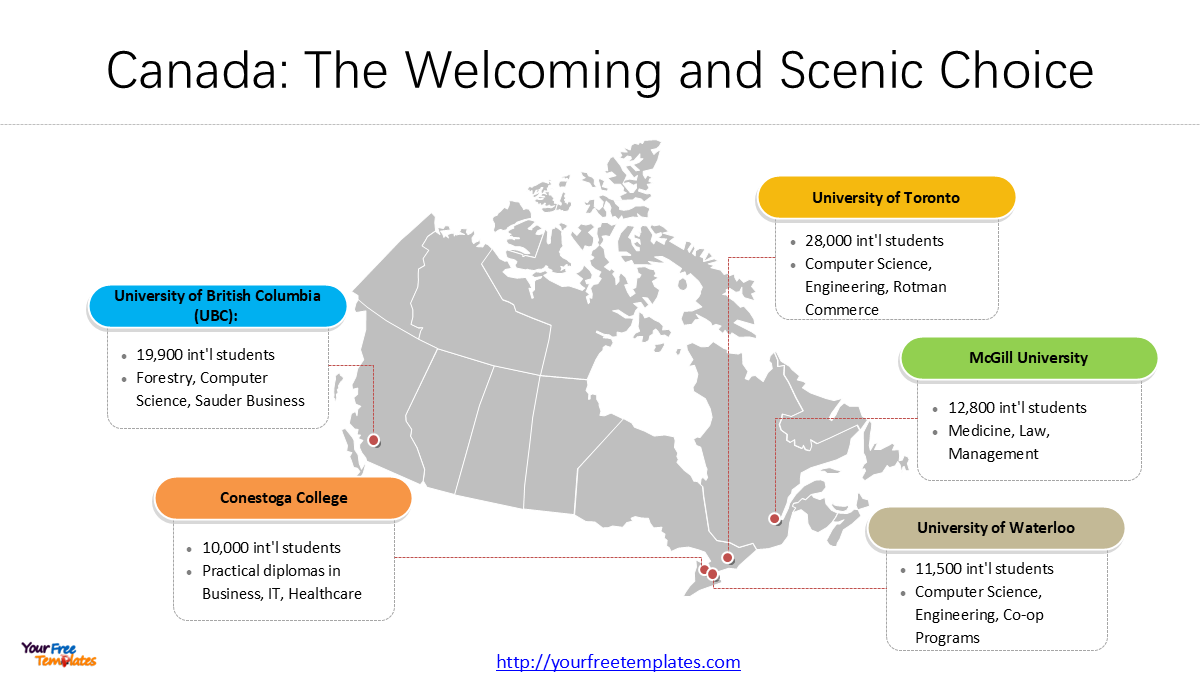
University of Toronto: Ontario | ~28,000 int’l students | Popular for: Computer Science, Engineering, Rotman Commerce.
-
University of British Columbia (UBC): British Columbia | ~19,900 int’l students | Popular for: Forestry, Computer Science, Sauder Business.
-
McGill University: Quebec | ~12,800 int’l students | Popular for: Medicine, Law, Management.
-
University of Waterloo: Ontario | ~11,500 int’l students | Popular for: Computer Science, Engineering, Co-op Programs.
-
Conestoga College: Ontario | ~10,000+ int’l students | Popular for: Practical diplomas in Business, IT, Healthcare.
-
-
Potential Risks: Rising cost of living in major cities like Toronto and Vancouver; extremely cold winters in many regions.
- Build your map with template Canada.
4. Australia: Sun, Surf, and Top-Tier Education
Australia combines a laid-back lifestyle with robust academic standards. Its major cities are consistently ranked among the world’s most livable, and post-study work visas allow graduates to gain valuable international experience.
-
Annual Cost: $20,000 – $40,000+
-
Best Programs: Medicine & Healthcare, Engineering, Environmental Science, Business, Hospitality.
-
Key Student Demographics: China and India form the largest cohorts, with a growing number of students from Nepal, Vietnam, and Brazil.
-
Post-Study Work Visa: Temporary Graduate Visa (subclass 485), lasting 2-4 years depending on the level of study.
-
Job Prospects: Very good, with high demand for skilled workers in healthcare, engineering, and tech. Pathways to permanent residency are clear for in-demand occupations.
-
Top Universities for International Students:
-
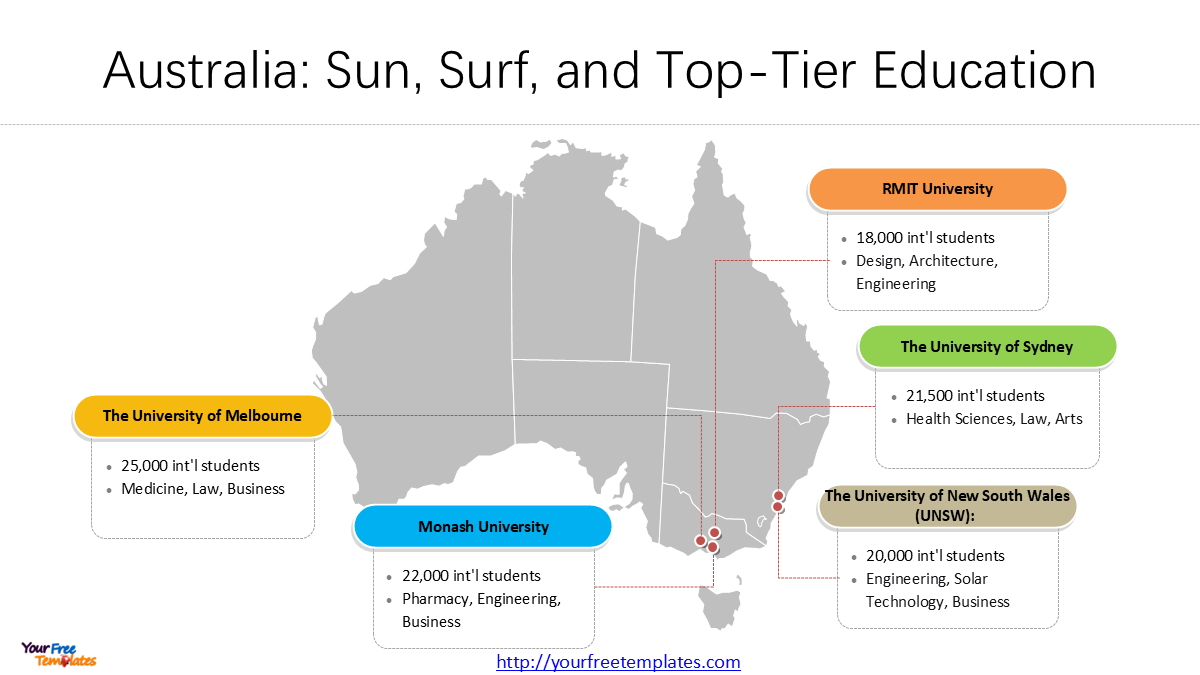
The University of Melbourne: Victoria | ~25,000 int’l students | Popular for: Medicine, Law, Business.
-
Monash University: Victoria | ~22,000 int’l students | Popular for: Pharmacy, Engineering, Business.
-
The University of Sydney: New South Wales | ~21,500 int’l students | Popular for: Health Sciences, Law, Arts.
-
The University of New South Wales (UNSW): New South Wales | ~20,000 int’l students | Popular for: Engineering, Solar Technology, Business.
-
RMIT University: Victoria | ~18,000 int’l students | Popular for: Design, Architecture, Engineering.
-
-
Potential Risks: High cost of living, geographic isolation from other global hubs, recent tightening of visa regulations for some pathways.
- Build your map with template Australia.
5. Germany: The Engineering and Affordability Hub
Germany is a dream destination for students seeking high quality at a low cost, with most public universities charging no tuition fees. It’s a global leader in engineering and manufacturing, offering a strong economy and excellent job opportunities.
-
Annual Cost: $10,000 – $20,000 (Primarily for living expenses)
-
Best Programs: Mechanical/Automotive Engineering, Computer Science, Renewable Energy, Natural Sciences.
-
Key Student Demographics: China and India are the top non-European senders. Within Europe, there are large numbers of students from neighboring countries like France, Austria, and Italy.
-
Post-Study Work Visa: An 18-month residence permit to seek a job related to their studies.
-
Job Prospects: Excellent, especially for engineers and IT specialists. Germany’s robust industrial sector actively seeks skilled graduates.
-
Top Universities for International Students:
-
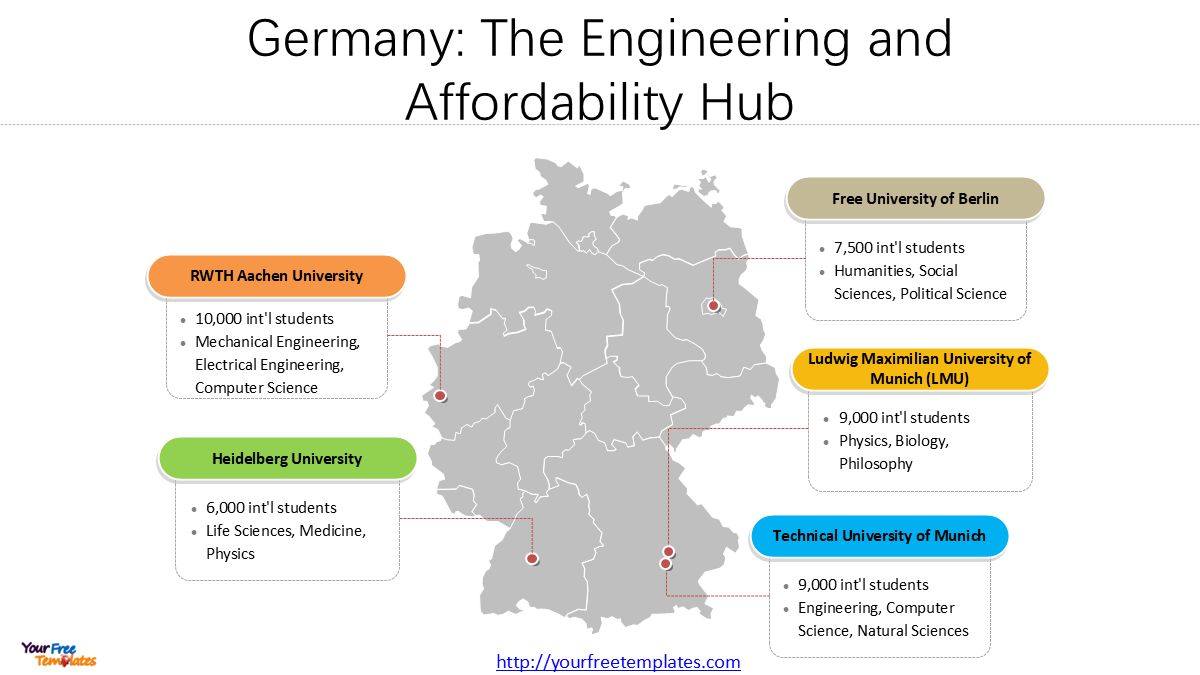
Ludwig Maximilian University of Munich (LMU): Bavaria | ~9,000 int’l students | Popular for: Physics, Biology, Philosophy.
-
Technical University of Munich (TUM): Bavaria | ~9,000 int’l students | Popular for: Engineering, Computer Science, Natural Sciences.
-
Heidelberg University: Baden-Württemberg | ~6,000 int’l students | Popular for: Life Sciences, Medicine, Physics.
-
Free University of Berlin: Berlin | ~7,500 int’l students | Popular for: Humanities, Social Sciences, Political Science.
-
RWTH Aachen University: North Rhine-Westphalia | ~10,000 int’l students | Popular for: Mechanical Engineering, Electrical Engineering, Computer Science.
-
-
Potential Risks: Necessity to learn German for most jobs outside of tech/MNCs; complex bureaucracy for visas and registration.
- Build your map with template Germany.
6. Netherlands: Innovative and English-Friendly
The Netherlands is a hidden gem with a huge number of English-taught programs and an innovative, problem-based teaching style. Its cosmopolitan and open-minded culture is perfect for students seeking a progressive European experience.
-
Annual Cost: $15,000 – $25,000
-
Best Programs: Agriculture & Food Sciences, Logistics, Water Management, Creative Industries, Economics.
-
Key Student Demographics: Germany, Italy, and other EU countries are the primary sources due to proximity and tuition agreements. China is the largest non-European contributor.
-
Post-Study Work Visa: Orientation Year Visa, allowing one year to search for employment.
-
Job Prospects: Good, with a high proportion of English-speaking jobs, particularly in tech and business. The high income threshold for the skilled migrant visa can be a challenge.
-
Top Universities for International Students:
-
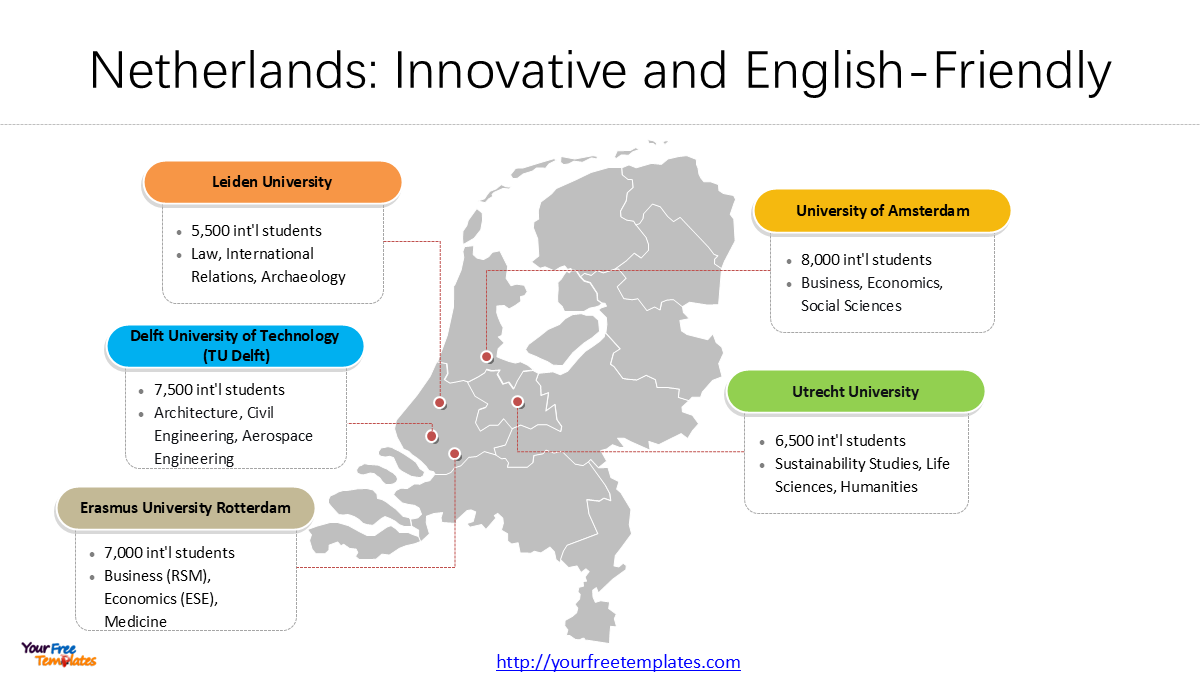
University of Amsterdam: North Holland | ~8,000 int’l students | Popular for: Business, Economics, Social Sciences.
-
Delft University of Technology (TU Delft): South Holland | ~7,500 int’l students | Popular for: Architecture, Civil Engineering, Aerospace Engineering.
-
Utrecht University: Utrecht | ~6,500 int’l students | Popular for: Sustainability Studies, Life Sciences, Humanities.
-
Erasmus University Rotterdam: South Holland | ~7,000 int’l students | Popular for: Business (RSM), Economics (ESE), Medicine.
-
Leiden University: South Holland | ~5,500 int’l students | Popular for: Law, International Relations, Archaeology.
-
-
Potential Risks: Competitive and expensive housing market; high income requirement for the long-term work visa.
- Build your map with template Netherlands.
7. Switzerland: Peak Quality in Life and Education
Switzerland offers exceptional quality in education and life, home to world-leading institutions in hospitality and science. While tuition is low, it is nestled in one of the world’s most expensive countries.
-
Annual Cost: $25,000 – $40,000 (Tuition is low, but living costs are very high)
-
Best Programs: Hospitality & Tourism Management, Finance, Pharmaceutical Sciences, International Relations.
-
Key Student Demographics: The student body is highly international but dominated by European neighbors like Germany, France, and Italy. China and the US are also key non-European partners.
-
Post-Study Work Visa: Strict quotas for non-EU work permits make it challenging to stay long-term after graduation.
-
Job Prospects: Excellent for those who secure a position, but the market is fiercely competitive and restricted for non-EU citizens.
-
Top Universities for International Students:
-
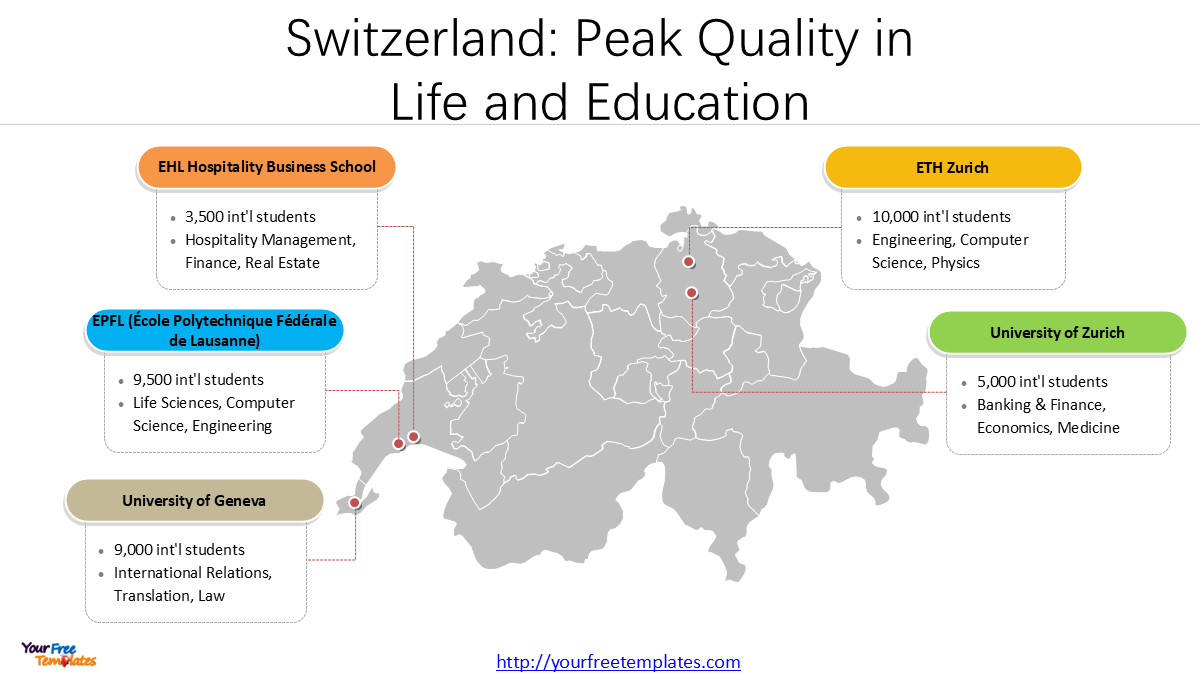
ETH Zurich: Zurich | ~10,000 int’l students | Popular for: Engineering, Computer Science, Physics.
-
EPFL (École Polytechnique Fédérale de Lausanne): Vaud | ~9,500 int’l students | Popular for: Life Sciences, Computer Science, Engineering.
-
University of Zurich: Zurich | ~5,000 int’l students | Popular for: Banking & Finance, Economics, Medicine.
-
University of Geneva: Geneva | ~9,000 int’l students | Popular for: International Relations, Translation, Law.
-
EHL Hospitality Business School: Vaud | ~3,500 int’l students | Popular for: Hospitality Management, Finance, Real Estate.
-
-
Potential Risks: Extremely high cost of living; fiercely competitive and restricted job market for non-EU graduates.
- Build your map with template Switzerland.
8. Singapore: Asia’s Global Academic Hub
A dynamic city-state, Singapore serves as a perfect gateway to Asia with its world-class universities and strong emphasis on innovation and business. It provides a safe, efficient, and multicultural environment for students.
-
Annual Cost: $18,000 – $30,000
-
Best Programs: Business, Technology, Engineering, Law.
-
Key Student Demographics: China and Malaysia are the largest sources, with significant numbers also coming from India, Indonesia, and other ASEAN countries.
-
Post-Study Work Visa: Eligibility for a pass is tied to salary, university ranking, and employer demand.
-
Job Prospects: Very good for top graduates, particularly in finance, tech, and engineering. The government actively encourages talent retention.
-
Top Universities for International Students:
-
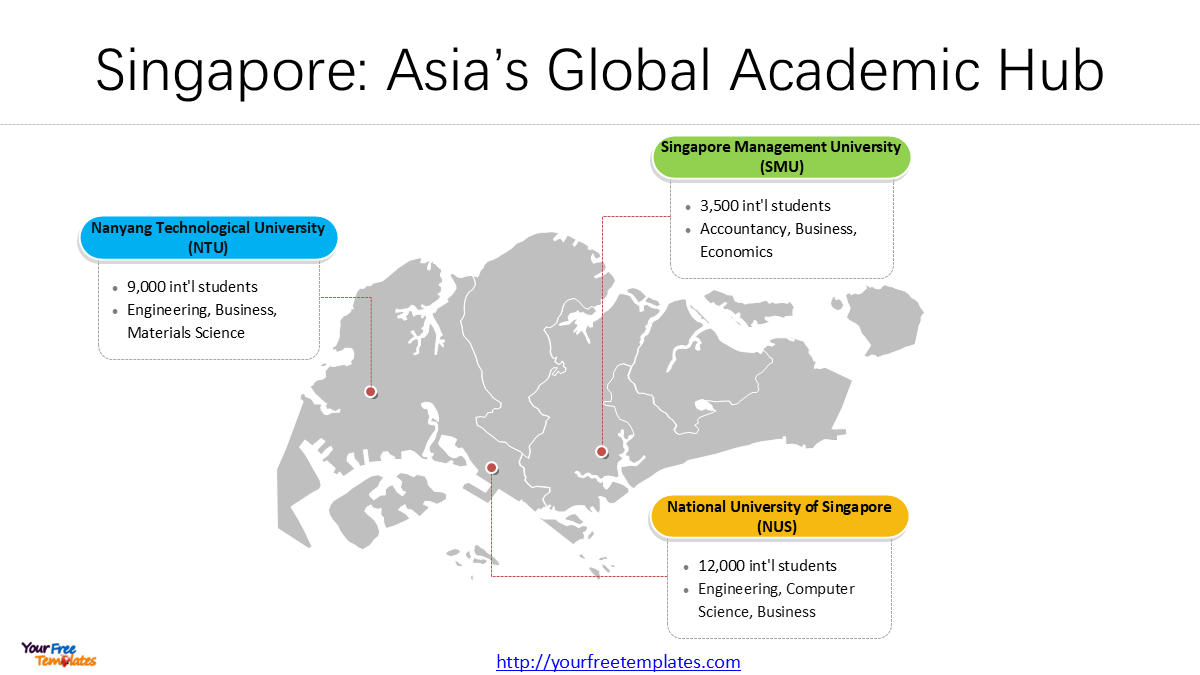
National University of Singapore (NUS): Singapore | ~12,000 int’l students | Popular for: Engineering, Computer Science, Business.
-
Nanyang Technological University (NTU): Singapore | ~9,000 int’l students | Popular for: Engineering, Business, Materials Science.
-
Singapore Management University (SMU): Singapore | ~3,500 int’l students | Popular for: Accountancy, Business, Economics.
-
-
Potential Risks: High competitive pressure; work pass policies can change; limited personal space.
- Build your map with template Singapore.
9. Sweden: Sustainability and Innovation
A leader in sustainability, design, and innovation, Sweden offers a unique education system that encourages critical thinking for students study abroad. It features a high standard of living and a thriving tech sector that attracts global talent.
-
Annual Cost: $15,000 – $25,000 (Tuition for non-EU students)
-
Best Programs: Environmental Science, Sustainable Technology, Design, Computer Science.
-
Key Student Demographics: India and China are the primary non-European sources. Within Europe, Germany and Finland send a considerable number of students.
-
Post-Study Work Visa: 12 months to seek employment after graduation.
-
Job Prospects: Growing, especially in the tech and engineering sectors. Learning Swedish significantly expands opportunities.
-
Top Universities for International Students:
-
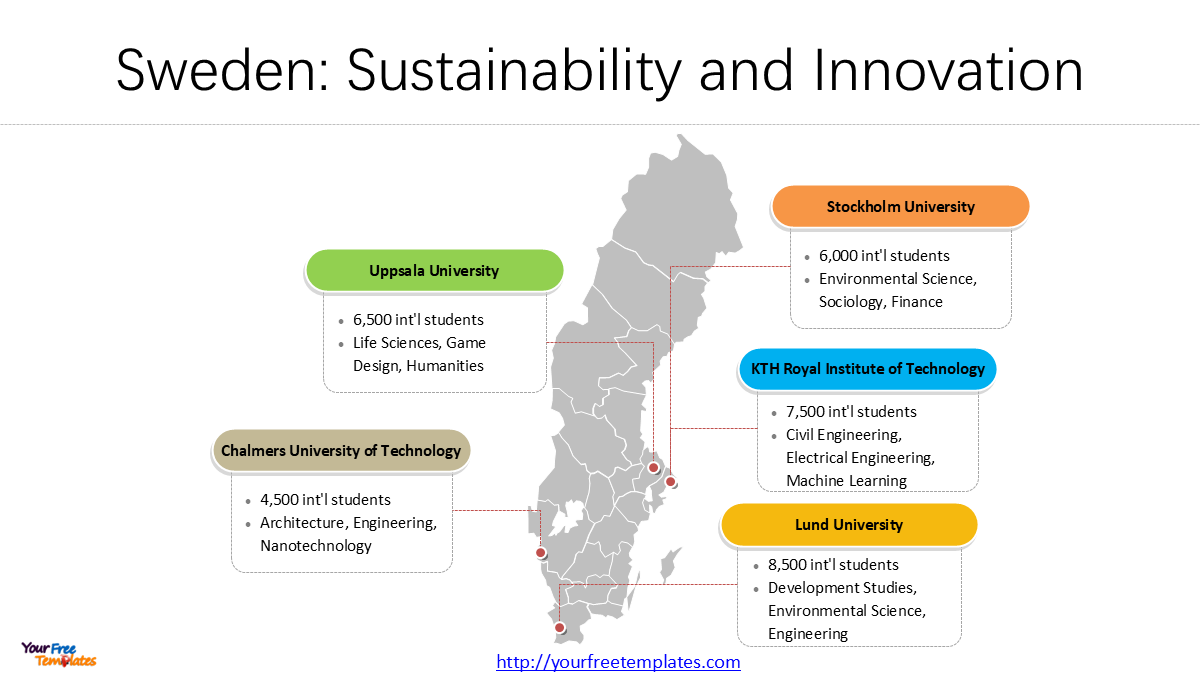
Lund University: Scania | ~8,500 int’l students | Popular for: Development Studies, Environmental Science, Engineering.
-
KTH Royal Institute of Technology: Stockholm | ~7,500 int’l students | Popular for: Civil Engineering, Electrical Engineering, Machine Learning.
-
Uppsala University: Uppsala | ~6,500 int’l students | Popular for: Life Sciences, Game Design, Humanities.
-
Chalmers University of Technology: Gothenburg | ~4,500 int’l students | Popular for: Architecture, Engineering, Nanotechnology.
-
Stockholm University: Stockholm | ~6,000 int’l students | Popular for: Environmental Science, Sociology, Finance.
-
-
Potential Risks: High cost of living; challenging weather; necessity of Swedish for full social and career integration.
- Build your map with template Sweden.
10. Japan: A Blend of Ancient and Futuristic
Study abroad in Japan offers a unique cultural experience alongside top-tier education in technology and robotics. The government is actively internationalizing its universities and seeking to retain more global talent.
-
Annual Cost: $12,000 – $20,000
-
Best Programs: Robotics, Engineering, Anime & Game Design, Japanese Language & Culture.
-
Key Student Demographics: China and Vietnam are the two largest sending countries, followed by Nepal and South Korea.
-
Post-Study Work Visa: Possible to change status upon finding a relevant job, but the process is structured and can be difficult.
-
Job Prospects: Good for graduates with high Japanese language proficiency. The job-hunting process (shūkatsu) is rigid and traditional.
-
Top Universities for International Students:
-
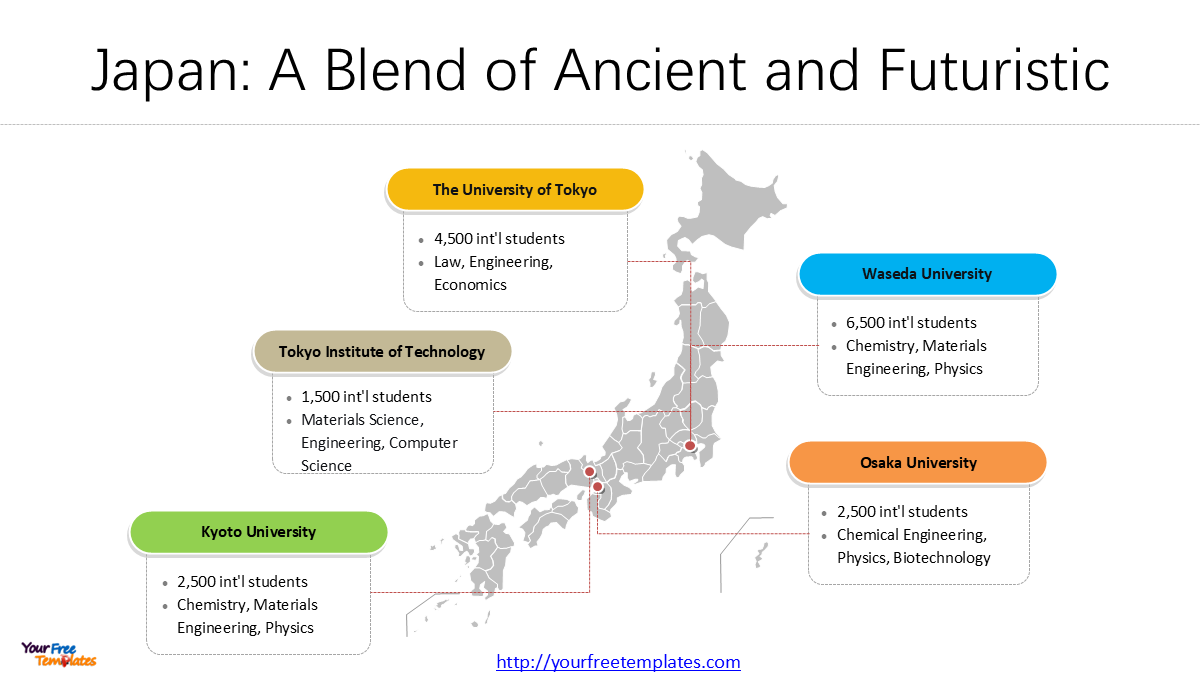
The University of Tokyo: Tokyo | ~4,500 int’l students | Popular for: Law, Engineering, Economics.
-
Waseda University: Tokyo | ~6,500 int’l students | Popular for: Political Science, Economics, Business.
-
Kyoto University: Kyoto | ~2,500 int’l students | Popular for: Chemistry, Materials Engineering, Physics.
-
Tokyo Institute of Technology: Tokyo | ~1,500 int’l students | Popular for: Materials Science, Engineering, Computer Science.
-
Osaka University: Osaka | ~2,500 int’l students | Popular for: Chemical Engineering, Physics, Biotechnology.
-
-
Potential Risks: Significant language and cultural barriers; a rigid job-hunting system not designed for international students.
- Build your map with template Japan.
Conclusion:
Your choice of a study abroad should align with your academic, financial, and long-term career goals. By considering these detailed factors—from annual costs to potential risks—you can move beyond rankings and make a strategic, informed decision for your international education and future career.
Looking for Premium maps, please visit our affiliate site: https://editablemaps.com/ or https://ofomaps.com/